67-Year-Old Fulani GrandMa Shares The Forgotten Hair Preservation Method New Mothers Used To Protect Their Edges After Childbirth… Without Pills And Harsh Chemicals.
If your hair has been falling out since you gave birth, your edges are thinning, and every salon visit feels like another heartbreak, you’re about to discover the postpartum hair secret that Fulani people carefully kept all these years.
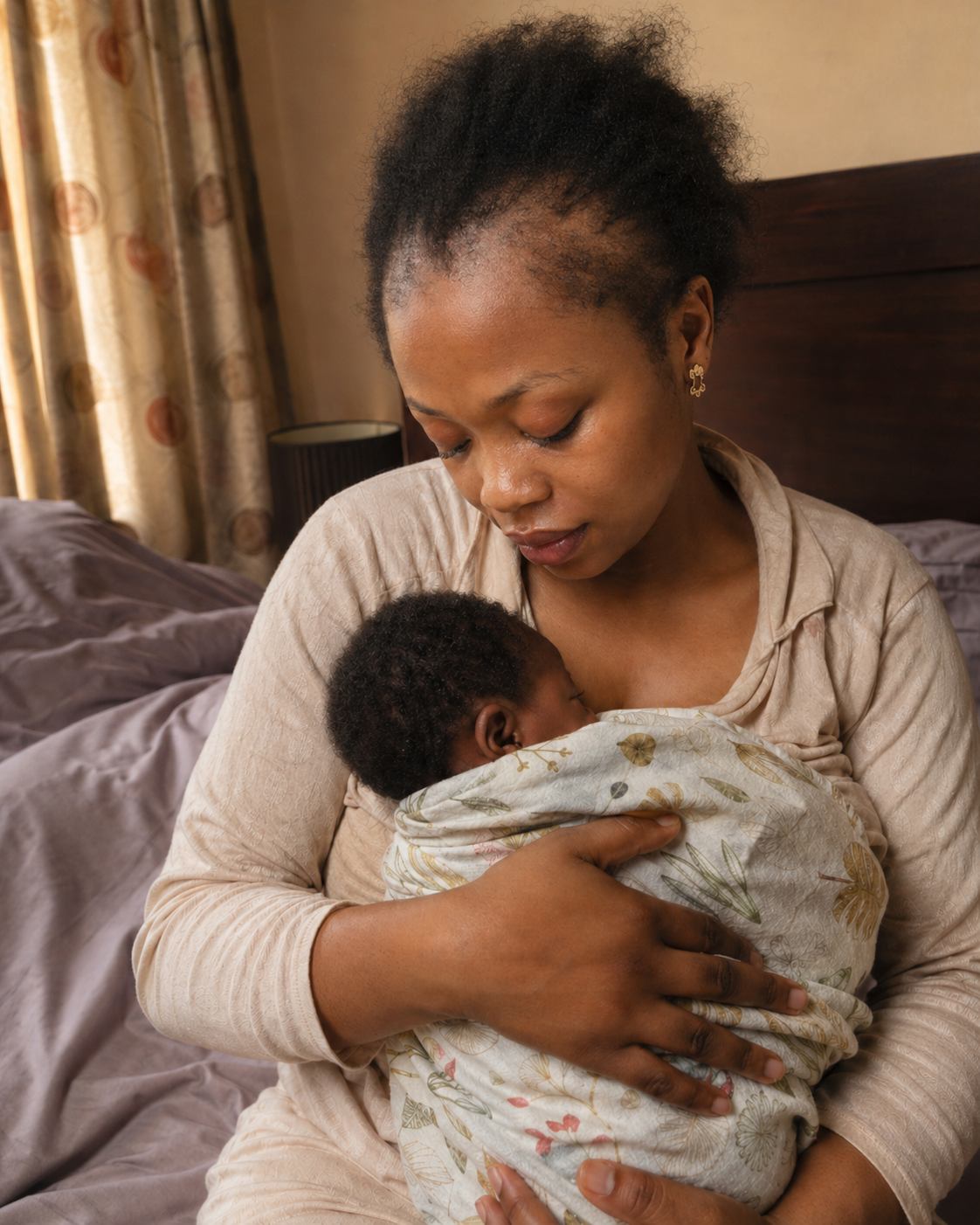
You love your baby. You thank God every day that you carried life, delivered safely, and now hold your child in your arms.
But there is one pain that makes your chest tighten. The kind of pain people think you should not be talking about.
Because anytime you mention how you’re struggling with hair loss after childbirth, someone quickly reminds you, “At least you and your baby are alive.”
And yes, you are grateful. Deeply grateful. But gratitude has not stopped your hair from falling. Gratitude has not filled your edges. Gratitude has not stopped your heart from sinking every time you see clumps of your hair in your comb.
You used to touch your hair without fear. Now, even running your fingers through it feels like a risk.
You stand in front of the mirror and gently pull your scarf back. You check the front. Then the sides. Then the middle. And before you know it, your mood has changed.
Because the woman staring back at you does not look like the woman you remember.
Her edges are thinner.
Her hairline looks tired.
Her face still looks like yours, but something feels missing.
You stop packing your hair back.
You avoid centre parting.
You wear scarves even when you are not going anywhere.
You use wigs to cover what you are not ready to explain.
And on salon day, you prepare your mind like someone going to hear bad news. Because you already know what is coming.
Hair in the sink. Hair on the towel. Hair in the comb. Hair on your clothes. Hair everywhere except where you need it to stay: on your head.
And in all of this, everybody keeps acting like you should not care.
As if wanting your hairline back makes you ungrateful. As if missing your old reflection makes you vain. As if a woman cannot love her baby deeply and still mourn the confidence childbirth took from her.
But you know the truth.
You are not sad over ordinary hair. You are sad because you are tired of losing parts of yourself one strand at a time.
You are tired of pretending it does not hurt. You are tired of hoping every new oil, shampoo, herb, or protective style will finally be the one that works. And you are tired of being told to “just wait” while your edges keep getting weaker.
Here’s What Nobody Told You
Postpartum hair loss is not just “hair falling.”
After childbirth, your body changes. One of the biggest changes affects the hormones that helped keep your hair full during pregnancy.
When those hormones drop, many strands can enter the shedding stage around the same time. That is why your hair may suddenly start falling more than usual.
But no one is talking about this part. The shedding is only one side of the problem.
The bigger damage often happens after the shedding starts.
Because your hair is already weak. Your edges and hair strands are already fragile.
- Tight styles
- Rough combing
- Strong shampoos
- Hot dryers
- Heavy oils
- New herbs every week
- Salon handling that pulls your front hair
- Wig lines that press the same weak spots again and again
And before long, normal postpartum shedding begins to look more frightening.
Not because your village people followed you. Not because you are careless. But because weak postpartum hair needs preservation before growth.
That was the part I did not understand. I kept trying to force my hair to grow. But my hair first needed to be protected.
I know this because I lived it
My name is Ifeoma. I am 31 years old. I am a Nigerian woman, a new mum, and for months after childbirth, I was quietly afraid of my own hair.
At first, I told myself it was nothing serious. People kept saying, “It is normal.” My mum said, “Don’t worry, it will grow back.” My sisters said, “You just gave birth. Allow your body to rest.”
Even my husband, Ugo, tried to comfort me.
One evening in our room in Lagos, I stood in front of the mirror, holding my front hair with two fingers. I said, “Babe, look at my edges.” He looked up from his phone and said, “It is not that bad now.”
I wanted to believe him. But I knew what my hair used to look like. I knew the difference.
Before childbirth, my front hair was soft and full. I could pack my hair back without fear. I could wash my hair without praying first.
After I gave birth, everything changed.
At first, I saw a few strands on my pillow. Then I saw more hair in the bathroom. Then hair started appearing in my comb, on my clothes, everywhere.
That one broke me.
I remember carrying my baby one afternoon and seeing strands of my hair on her wrapper. I removed them slowly and just sat there.
I did not cry at first. I just felt empty. Like my body had already changed so much, and now my hair was leaving too.
Motherhood had already taken my sleep. My body did not feel like mine. My stomach was different. I could barely get enough sleep. I was always tired.
Add all of that to postpartum hair loss. My hair was falling out in clumps.
I began avoiding mirrors. I would tie scarves even when I was indoors. If someone came to visit, I quickly adjusted my scarf before opening the door.
I hated salon days. Because I knew my hair would be ripped out. And I’d be coming home with less hair than what I went to the salon with.
I tried all the normal things first. They did not solve it.
Once, at a salon in Surulere, the girl combing my hair said, “Aunty, your front hair don thin finish o.”
I forced a smile and said, “Yes, I just had a baby.” Inside, I wanted to disappear.
That was when I started buying everything people recommended.
First, I bought hair growth oils. One came in a small bottle with a label that promised fast edges growth. The vendor on Instagram had pictures that looked convincing.
Then someone told me to try herbs. I spent almost ₦20,000 buying different things. Rosemary. Fenugreek. Mint leaves. Neem powder.
Then I tried shampoos. I bought four bottles from one brand because I wanted to stay loyal to the regimen.
I told myself, “Maybe consistency is the problem.” So I washed. I followed instructions. I waited.
But during that period, it felt like the shedding became worse.
Salon days became a nightmare. I would see the hair in the sink and feel my stomach drop.
Then I tried Minoxidil, a topical hair growth treatment people online kept recommending.
In the first three weeks, I thought I saw some changes. I became hopeful. But new-mum life does not always obey routines.
Some nights, I slept without using it. Some mornings, my baby was crying and I forgot. Some days, I was too tired to do anything apart from survive.
When I became inconsistent, the shedding came back. That was the part nothing prepared me for.
I found out that Minoxidil only helps while you stay consistent with it. Once you stop using it, the little progress you made disappears.
That broke my confidence again.
After that, I said, “Let me just leave the hair alone.” So I switched to protective styles. I thought braids, cornrows, and wigs would save me.
But I was wrong.
Maybe the styles were too tight. Maybe the stylist was too rough. Maybe my edges were already too weak. All I know is I almost no longer had front hair.
The styles that were meant to protect me became another problem.
Then I started hiding
Wigs. Scarves. Headbands. Anything that covered the front.
Even when I dressed well, I did not feel beautiful.
One day, my sister Chidinma came to visit. She saw me adjusting my scarf and said, “Ifeoma, leave this hair thing. You just had a baby.”
I looked at her and said, “You people keep saying that. But you are not the one watching your hair disappear.”
The room went quiet. I felt bad after saying it. But it was the truth.
Nobody talks enough about this part of motherhood.
They talk about safe delivery. They talk about breastfeeding. They talk about sleepless nights. They talk about baby weight.
But they do not talk about how painful it is to look at your hairline and feel your confidence leaving.
They do not talk about the quiet shame. They do not talk about the fear of looking older, rougher, and less like yourself.
My turning point came in Adamawa
I had travelled for my maid of honour’s wedding. Her name is Hauwa. We had been friends for years, and I could not miss her wedding, even though I almost cancelled.
I was tired. My baby was about 5 months. My edges were weak. And I was thinking of what to do to my hair for the event.
At the wedding, I noticed a woman standing near the food table. She had also just had a baby. I could tell from the way she carried herself.
But her hair was full. Her edges were sitting well. Her hairline looked untouched.
I tried not to stare. But I stared.
It was later that evening that we ended up talking. Her name was Samira. Hauwa’s husband’s younger sister.
We started talking about the baby. About sleep. About how the body changes. The normal things new mothers talk about when they find each other.
At some point, I could not hold it anymore. I said, almost like I was confessing something, “Please don’t be offended. Did your hair not fall after giving birth?”
She looked at me for a moment before answering, “It started o. But my own was handled early.”
I asked her what she used. She smiled but did not answer immediately. She said she would think about it and we exchanged numbers before the night ended.
Three days later, she called.
She told me about a woman in their town. Hajiya Maimuna. An older woman who knew the postpartum hair preservation method that Fulani women had used for generations.
Samira said she would ask if the woman was willing to speak with me, but she made it clear that Hajiya Maimuna did not speak with just anyone.
I waited for another week. Then Samira called again. She said Hajiya Maimuna had agreed to see me but that I would need to come to Adamawa.
The woman did not do phone calls. She did not explain herself over the phone. If I was serious, I would come.
I almost said no.
I was not about to leave my baby again. The journey felt like too much. Emeka thought I was being extreme. He said, “You want to travel again because of hair?”
I understood why he said it. But I also knew that I had spent months buying things that did not work. And all I wanted was just to feel like myself again.
I had already spent more than ₦87,000 on products, oils, and treatments that made no real difference. What was a trip compared to that?
Then I met Hajiya Maimuna
I went back to Adamawa two weeks later. Samira took me to meet Hajiya Maimuna on a quiet afternoon.
She was 67 years old. Calm. Warm. Sharp-eyed. The kind of woman who does not rush her words because she knows what she knows.
She looked at my edges for a while, then asked me what I had been using. I started listing everything. Oils. Shampoos. Herbs. Treatments.
“My daughter, after childbirth, the hair doesn’t need plenty things.
It needs the right herb at the right time. If you use the wrong thing too early, or the right thing the wrong way, the hair will not answer you.”
That sentence stayed with me.
Because for months, I had been treating my hair like any other hair problem. But she was showing me that postpartum hair had its own timing.
I almost cried. Because that was when I realized I’d been using my scalp and hair as a guinea pig.
She explained that Fulani women had a careful postpartum hair preservation method that was passed among women.
Not shouted in public. Not treated like ordinary beauty gossip. It was the kind of women’s knowledge shared privately. Mother to daughter. Elder to younger woman. Auntie to new-mother.
She said the aim was not to force hair to grow overnight. The aim was to protect what was still there. To reduce stress on the hairline. To treat the hair like something recovering, not something stubborn.
For the first time, everything made sense.
My mind went back to the Fulani women I had seen since childhood. In markets. On the road. The ones passing through town.
Many of them were mothers. Most had carried several pregnancies. Yet their hair often looked thick, long, and never thinning or receding.
Their hairlines had that full, soft look many women quietly admire. And there I was, after just one baby, scared to touch my own edges.
That was when I began connecting the dots.
My hair needed preservation.
What changed after I got back to Lagos
When I got back to Lagos, I started following what she taught me.
But I did not just follow it casually.
I wrote everything down. What I did. When I did it. What I stopped doing. What changed. What made shedding look worse. What helped my scalp feel calmer. Which styles protected my edges. Which styles pulled them.
I tracked salon visits. I tracked shedding. I tracked my hairline. I tracked the small changes that gave me hope.
By the end of the first week, I was no longer afraid of touching my hair.
By the second week, salon handling no longer felt like a battle because I knew what to refuse.
By the third week, I noticed less hair in my comb.
By the sixth week, my edges looked calmer and fuller than they had in months.
Was it overnight? No.
Was it magic? No.
But it was the first thing that gave me peace.
And after three to four months of steady care, I looked in the mirror one morning and smiled.
Because my hair looked like what it used to be.
And Now, 15 months Postpartum, my hair is growing and blooming like a weed.
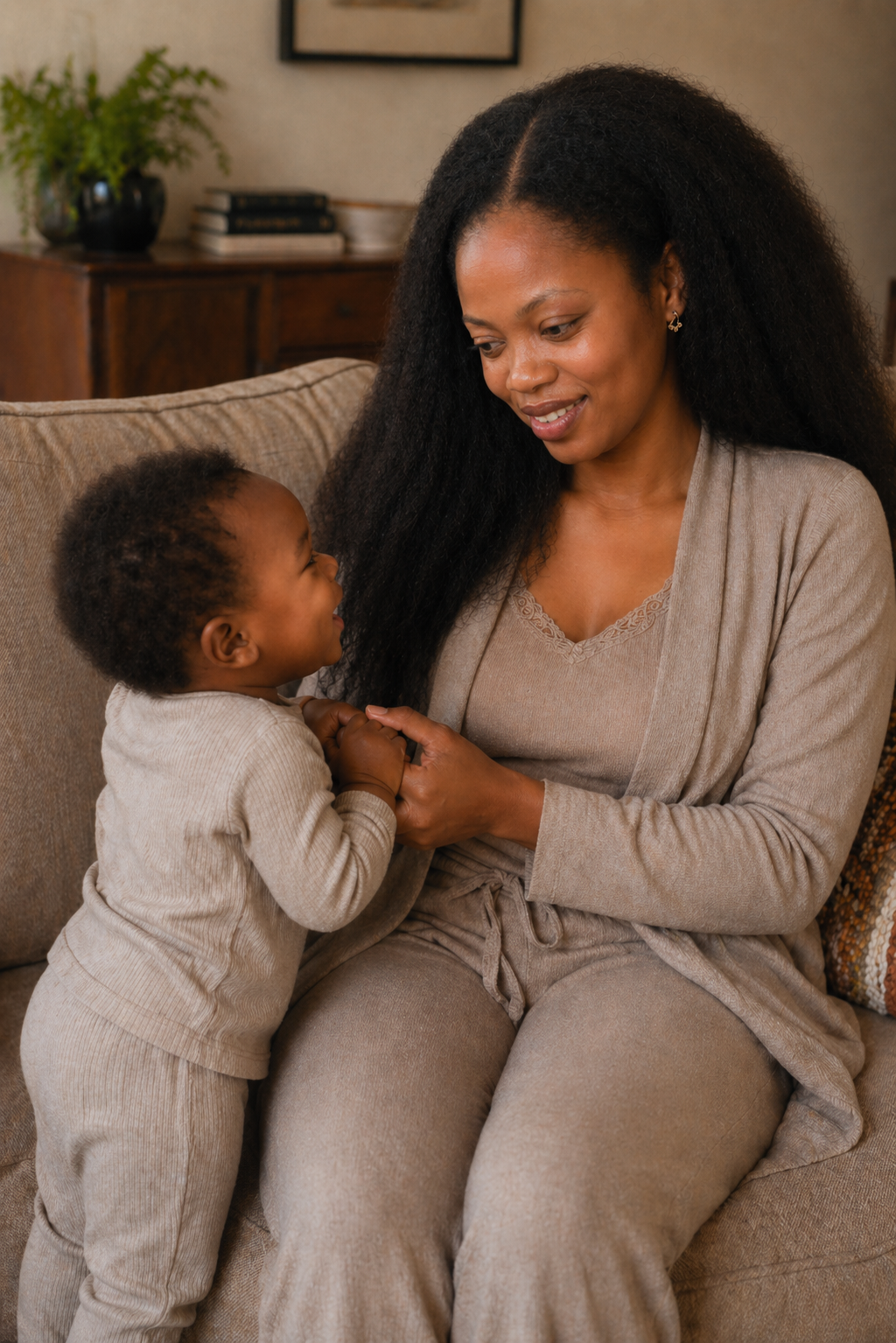
And I decided I was not going to keep this to myself.
I realized that many new mums were struggling with postpartum hair loss and needed all the help.
That was how Hajiya Maimuna’s Postpartum Hair-Loss Rescue Method was born.
For the new mum who is tired of being told to “just wait.”
For the woman who is grateful for her baby but still wants to feel beautiful.
For the mother who has spent money on products that did not work.
For the woman whose edges need care, not shame.
For you.
The Results Timeline
Week 1: You Stop Making The Damage Worse
The first week is not about doing plenty things. It is about stopping the silent habits that are stressing your edges. You learn what to avoid. You learn how to handle your hair without fear. You begin to see that your hair does not need panic. It needs care.
Week 2: Salon Visits Start Feeling Different
By the second week, you stop sitting quietly while someone pulls your front hair. You know what to say. You know what to refuse. You know when a style is too much for your current hair condition. Your confidence begins to return because you finally understand what your hair needs.
Week 3: The Comb Starts Looking Less Scary
Around the third week, many women begin to notice less avoidable breakage. Not because shedding has vanished overnight. But because weak hair is no longer being handled anyhow. Your comb may still have hair. But it may no longer feel like your heart is dropping every time you look at it.
Week 4: Your Edges Begin To Look Less Stressed
By week four, your hairline may start looking calmer. You are no longer hiding under tight styles that make the problem worse. You start taking small progress pictures. You may even begin to feel hopeful again.
Week 5: You Stop Feeling Powerless
By week five, the fear begins to reduce. You know your routine. You know your rules. You know what your hair can handle. You are no longer jumping from product to product. That alone can bring peace.
Week 6: You Start Seeing The Reward Of Staying Gentle
By week six, many women may notice better-looking edges, less avoidable breakage, and a calmer hair routine. The bigger change comes with steady care. For many women, the fuller transformation begins to show over 3 to 4 months.
Social Proof
Real Messages From Women Using The Method
Swipe left or right to view more testimonials.
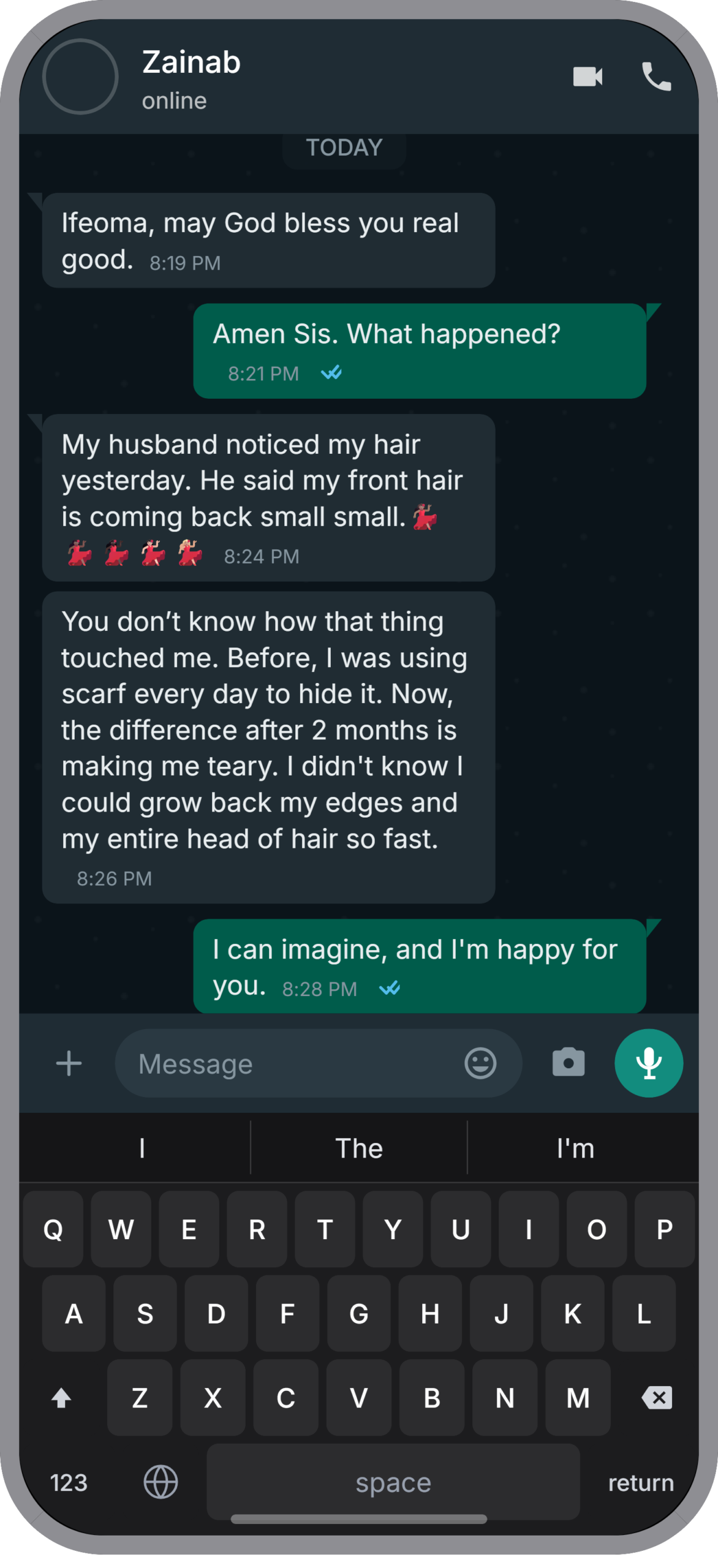
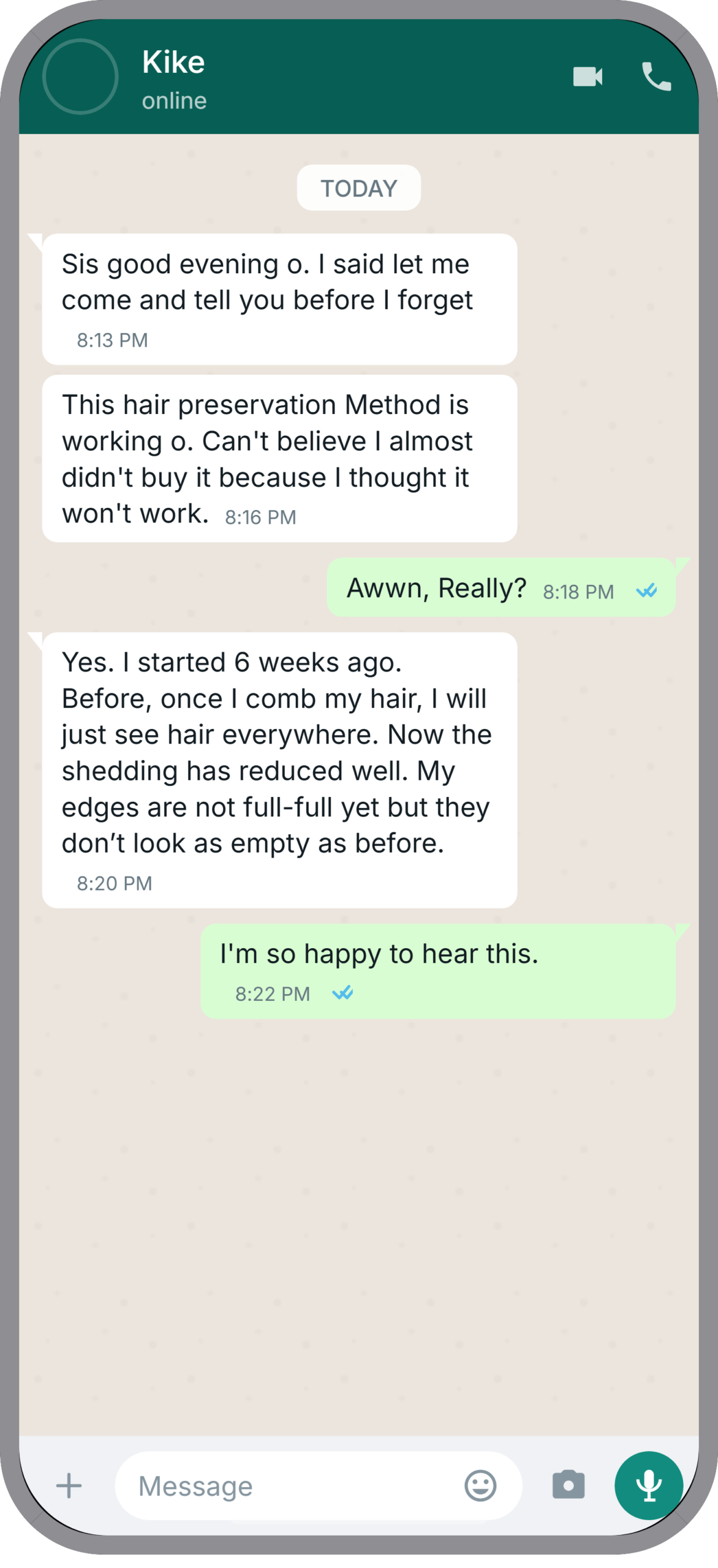
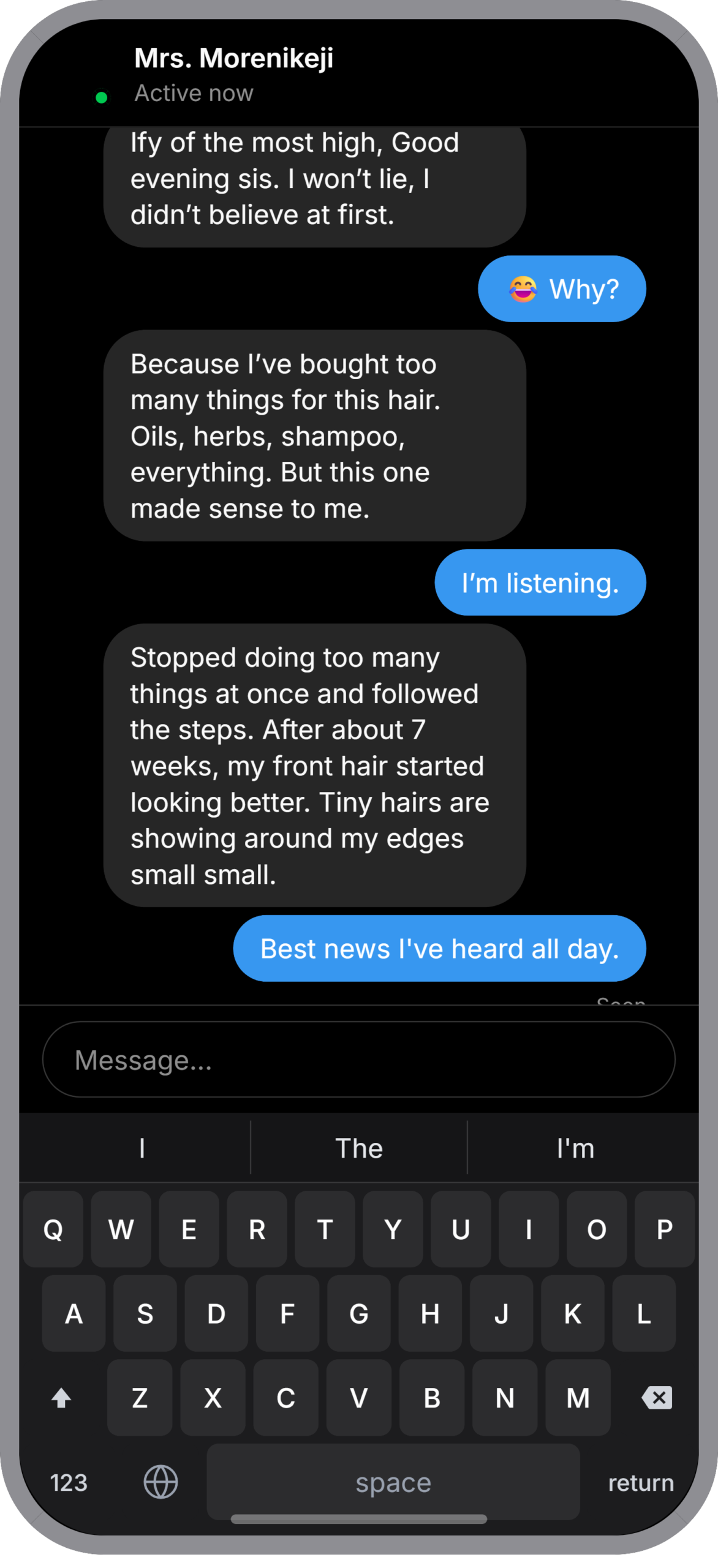
“Good evening sis. I no go lie, I was tired before I bought this. My edges don suffer after baby. But after I followed the hairline rules and stopped those tight styles, I started seeing less hair for comb. Na small small, but e dey work. I feel hopeful again.”
“I was hiding under wigs every day. The part that helped me most was knowing what I was doing wrong. I stopped letting stylists pull my front hair and followed the routine. My edges are not perfect yet, but they look calmer now.”
“I used to cry after salon visits. I thought something was wrong with me. The explanation alone gave me peace. Now I understand that my hair needs preservation, not force. Thank you for making it simple.”
“I bought it because I was desperate, but I stayed because the method made sense. No plenty noise. No fake promise. Just clear steps. My shedding reduced after some weeks, and I stopped doing styles that were pulling my edges.”
“It reminded me of the kind of things older women used to know but never wrote down. I like that it does not ask me to swallow anything. It is gentle and easy to follow. My hairline is not perfect yet, but it looks better than when I started.”
By Now, You Already Understand Something Important.
Your postpartum hair does not need another random promise.
It needs a clear preservation method.
It needs the kind of careful routine that helps you protect weak strands, reduce avoidable breakage, and stop treating your hair like it is the enemy.
That is why I put everything Hajiya Maimuna taught me into a practical PDF you can start applying immediately.
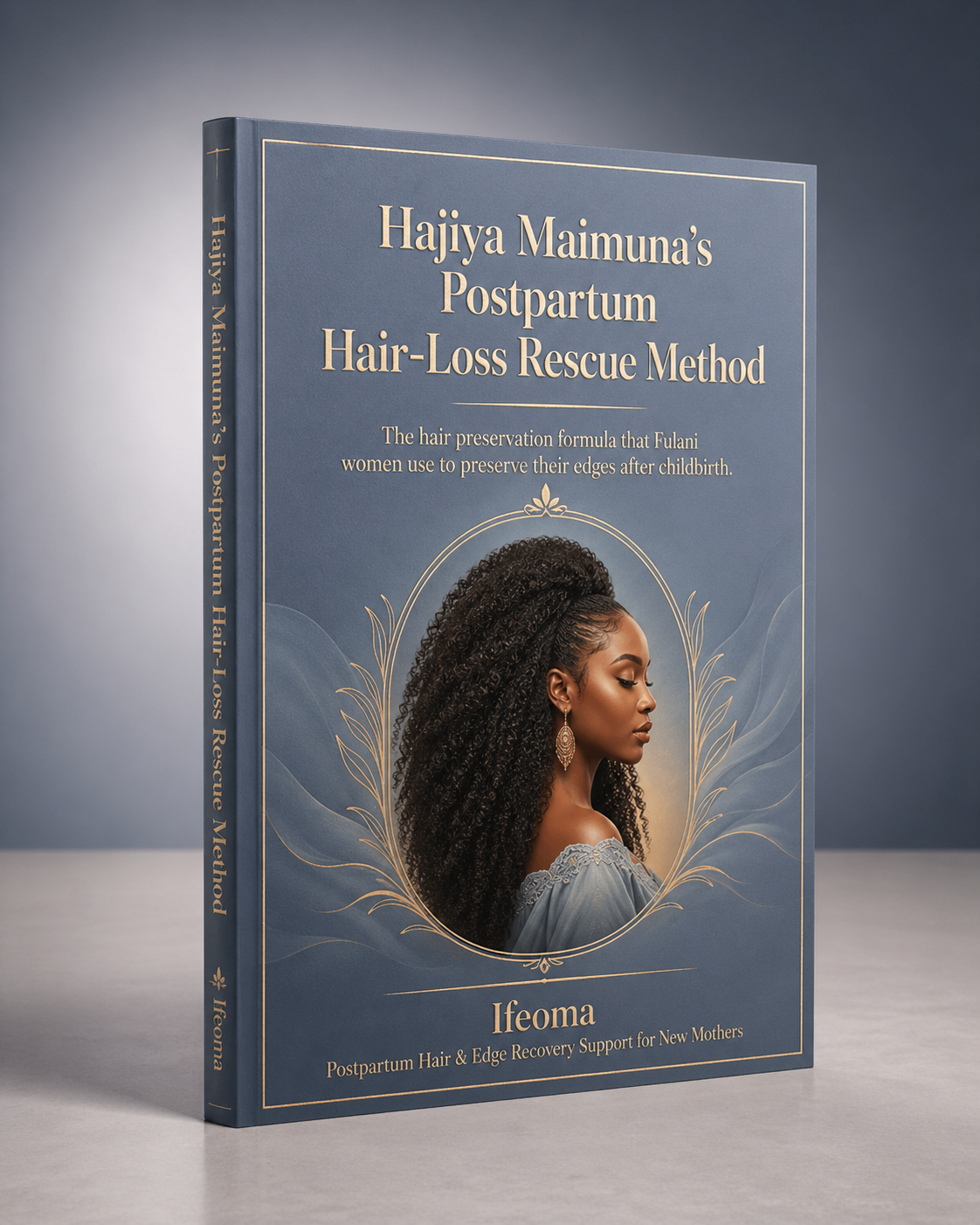
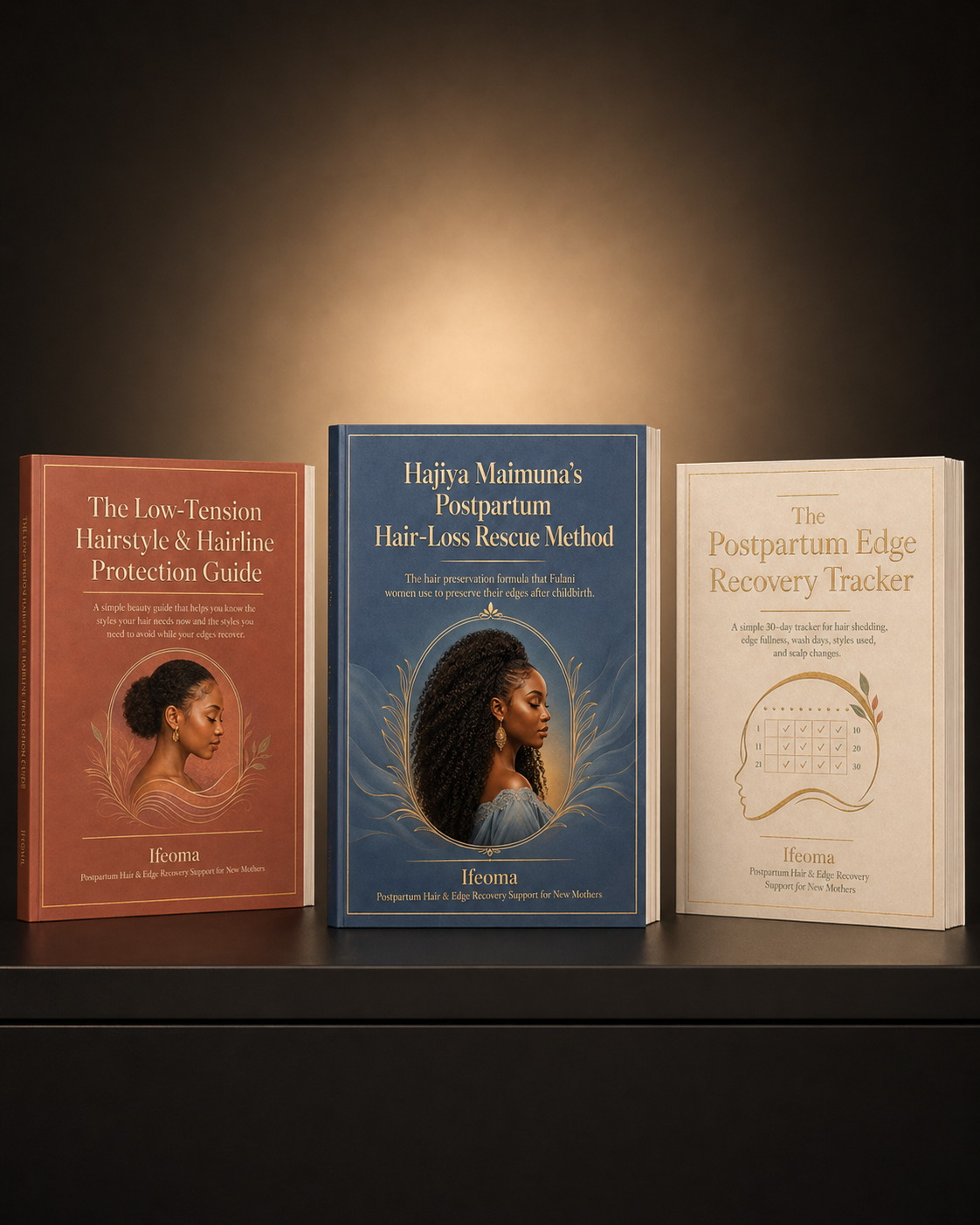
Introducing: Hajiya Maimuna’s Postpartum Hair-Loss Rescue Method
The hair preservation formula that Fulani women use to preserve their edges after childbirth.
No guesswork.
No scattered advice.
No exposing yourself at the pharmacy. No swallowing anything.
No harsh chemical routine.
Here is what is inside:
- The Postpartum Hair-Loss Truth — Pages 1–6
You will understand why your hair started falling after childbirth and why waiting without a plan may leave you more frustrated. - The Hair Strand Preservation Method — Pages 7–13
You will learn why weak postpartum hair must first be protected before you start chasing growth. - The Forgotten Fulani Method Explained — Pages 14–22
You will discover the private preservation approach Hajiya Maimuna shared, the herb and how to preserve its potency, the techniques, and why it works differently from other hair-loss that’s not postpartum induced. - The Private Preparation Method — Pages 23–28
You will get where to get it in your local market, the exact preparation steps, and use instructions for the preservation formula. Everything is clearly arranged so you can follow it from home. - The 3–4 Month Maintenance Plan — Pages 29–33
You will learn how to protect your progress and avoid going back to habits that weakened your edges in the first place.
Bonus Stack
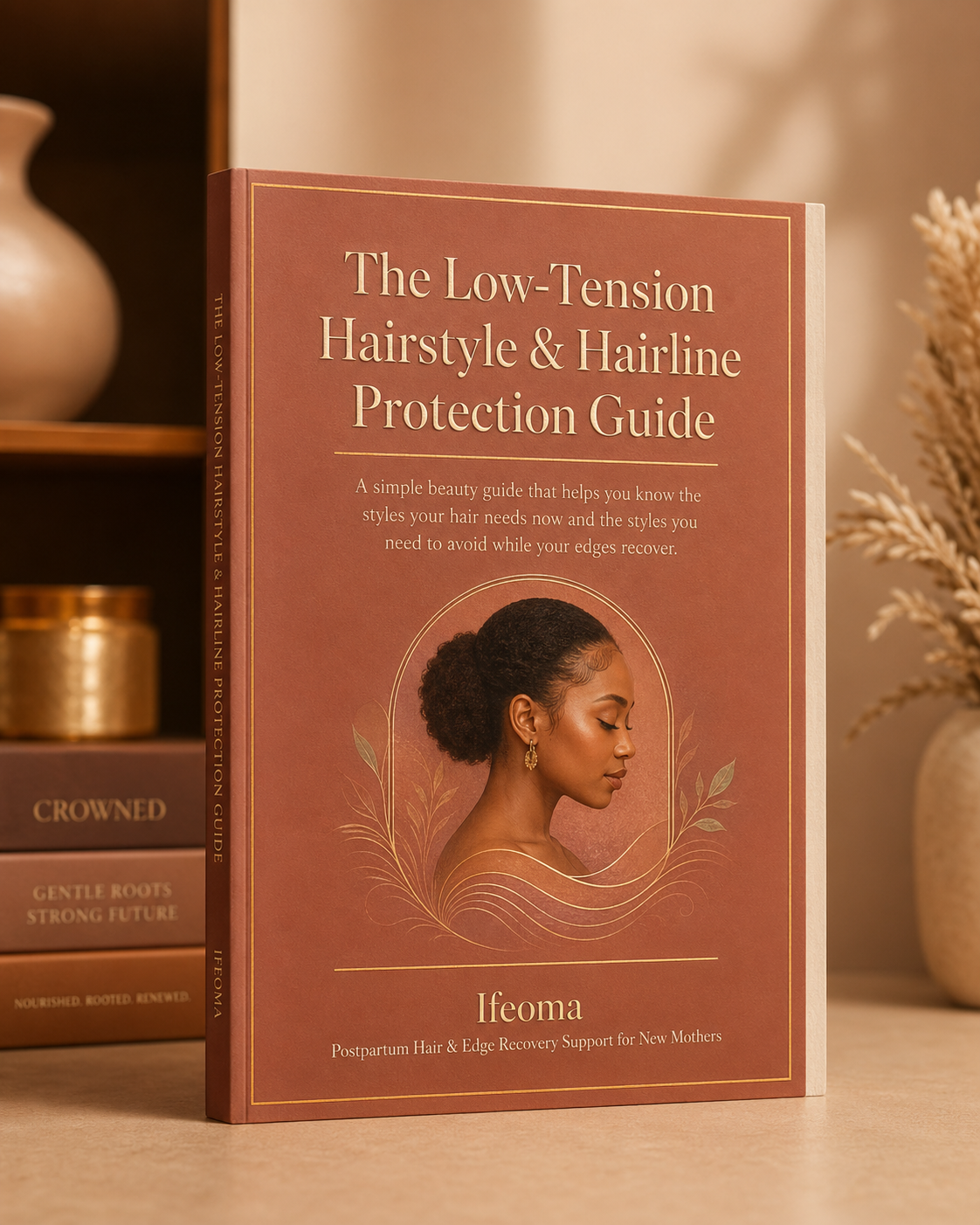
Bonus 1: The Low-Tension Hairstyle & Hairline Protection Guide
Standalone Value: ₦5,700
Many women think they are protecting their hair, but the style itself is quietly pulling their edges.
This guide shows you the kind of styles your hair needs now and the styles to avoid while your hairline is weak.
You will know what to tell your stylist. You will know when to say no. You will stop sacrificing your edges in the name of looking neat.
Bonus 2: The Postpartum Edge Recovery Tracker
Standalone Value: ₦3,200
Most women do not know what is helping or hurting their hair. They just keep buying, applying, styling, and hoping.
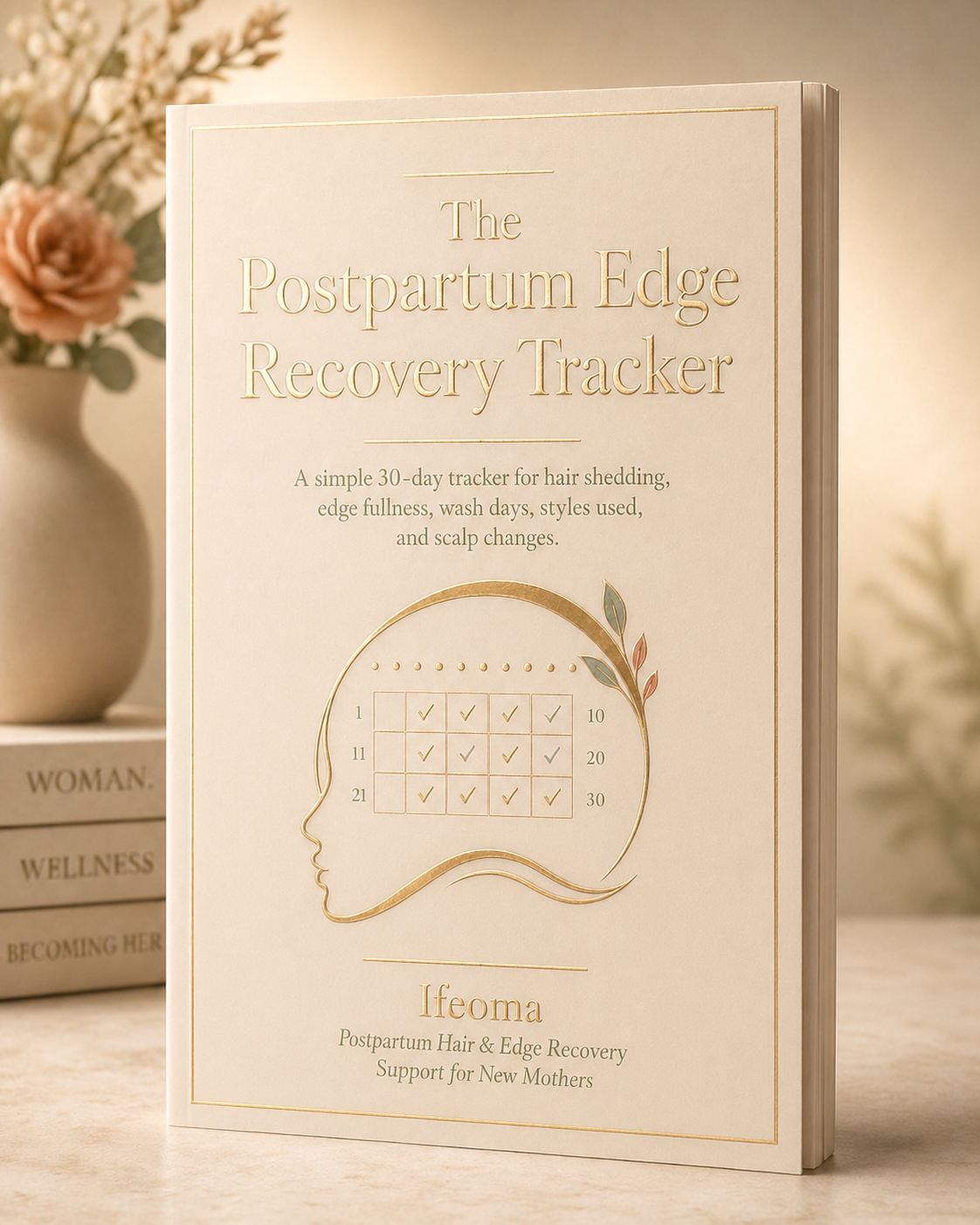
The tracker helps you monitor hair shedding, edge fullness, salon visits, wash days, styles used, and scalp changes for 30 days.
It gives you clarity. And clarity helps you stop repeating the same mistakes.
Offer Summary
| What You Get | Value |
|---|---|
| Hajiya Maimuna’s Postpartum Hair-Loss Rescue Method | ₦18,500 |
| Bonus 1: Low-Tension Hairstyle & Hairline Protection Guide | ₦5,700 |
| Bonus 2: The Postpartum Edge Recovery Tracker | ₦3,200 |
| Total Value | ₦27,400 |
Your Price Today:
That is less than what many people spend on one wig install.
Less than one salon visit that will still pull your edges.
Less than another random Instagram oil that may end up inside your drawer.
Less than the cost of repeating the same mistakes for another month.
Today, you can get the full method, the tracker, and the hairstyle protection guide for only:
But please note this.
After the first 35 buyers, I’d personally respond to the first 35 buyers who have a question about the method.
Right now I can still do that. But as more women come in, that will no longer be possible.
So if you buy now, you’d get direct access to me.
You’re Protected By Our 90-Day Guarantee
Try the method for 90 days. Follow the steps. Track your routine. Give your postpartum hair the calm care it needs.
If you see no improvement at all, ask for a full refund of your money.
And your money would be refunded to the last penny with a hand-written apology note for wasting your time.
No shouting. No back and forths.
You Can Choose To Close This Page…
And keep doing what you have been doing.
You can keep guessing.
Keep buying random products.
Keep hiding your edges under scarves and wigs.
Keep enduring the gaslighting and waiting for people to understand why this hurts.
You can keep waiting and hoping your hair grows back.
Maybe it’ll take one year, maybe two. Maybe it’ll never grow back.
And you’d keep hiding receded edges for the rest of your life.
But while you keep sitting on your hands, nothing changes today.
Or You Can Act Right Now
You can get the method today.
You can start with the first step.
You can begin a gentle routine that helps preserve the weak strands still on your head.
In 6 weeks, you could feel less afraid of salon visits.
You could understand what your hair needs.
You could look in the mirror and feel hope again.
Before You Close This Page, Remember This.
You have spent money on your baby's diapers without thinking twice.
You have bought formula, medications, baby clothes, and toys without calculating whether you deserved it.
Nobody questioned that.
Nobody called you vain for spending on your child.
But the moment you consider spending on yourself, something inside you hesitates.
You start calculating.
You start wondering if it is worth it.
You start thinking about what else that money could do.
And so you close the page.
You tell yourself you will sort it out later.
But later never comes.
Because there is always another bill.
Always another need.
Always another reason to push yourself to the back of the line.
But, at the end of the day, remember that you cannot pour from an EMPTY cup
A mother who feels confident and beautiful shows up differently.
For her baby.
For her husband.
For herself.
You are not spending on vanity.
You are spending on the version of yourself your family needs.
Your looks matter.
Your confidence matters.
You deserve to feel and look beautiful.
And you have spent long enough at the back of the line.
Six Weeks From Now, People May Feel The Change You Have Now Is Small… But You Will Know Something Has Changed
You may notice the change on a normal morning. Your baby is on the bed, making those giggles that remind you why you are grateful.
While getting ready to go out, you stand in front of the mirror. You move your hair back slowly. You look at your edges.
They may not be perfect yet. They may not be as full as before pregnancy. But small, tiny hairs are beginning to show around your edges.
And for the first time in a long time, you do not feel like crying.
Later that week, you go to the salon. Normally, salon day feels like judgment day. But this time, you sit down knowing what to say.
“Please, don’t pull my front hair. My edges are recovering.”
You say it calmly. No shame. No long explanation. And you mean it.
Because now, you understand what your hair can handle.
Your edges may not be perfect. You may still use your wig. You may still check your hairline more than you should. But the fear is not controlling you the same way.
You are no longer buying every oil Instagram pushes in your face. You are no longer mixing random things because one aunty said it worked for her neighbour.
You are no longer sitting alone after wash day, staring at shed hair like your confidence is leaving with it.
You have a routine now.
That line above could be your story if you choose to get your hair the help it needs.
That is the kind of change this method was created to help you start.
Not magic. Not fake overnight promises. Just the calm feeling of knowing your hair is no longer being neglected, and is now thriving.
Triple P.S.
P.S. You are protected by the 90-day guarantee, so you are not carrying the risk alone.
P.P.S. Direct access to me is only available for the first 35 buyers. After that, it will be removed from this offer.
P.P.P.S. You are not vain for wanting your hair back. You are a woman, a mother, and you deserve to feel beautiful after childbirth.