After A Bad Tear From My First Birth Left Me Stitched And Afraid To Sit, Pee, Or Poo… A 41-Year-Old Israeli-Trained Nigerian Midwife Revealed The Ancient Hebrew Birthing Method That Helps You Prepare Your Body For Vaginal Delivery And Reduce Your Risk Of Tearing… Even If They’ve Said Your Baby May Be Big.
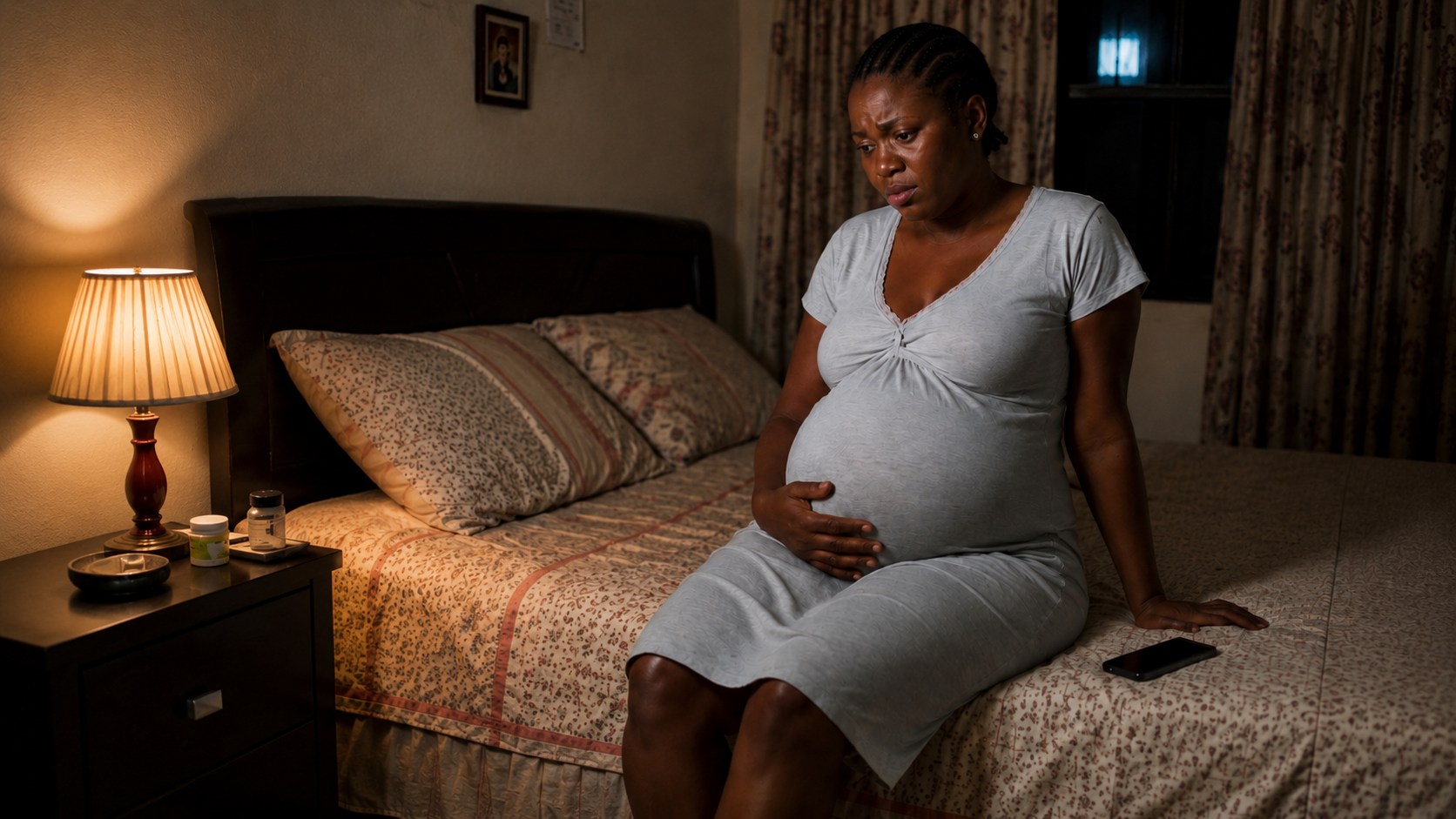
You grew up hearing women pray to “deliver like the Hebrew women.” But now that your due date is closer, the fear is getting real.
You do not just want to give birth.
You want to come out whole.
You want to carry your baby without feeling like your body has been torn apart.
You want to sit, pee, poo, walk, and clean yourself after birth without crying in secret.
You want people to say, “Thank God, mother and baby are fine,” and for that to truly mean you are fine too.
You are scared of vaginal birth.
You are scared of tearing badly.
You are scared of being stitched.
You are scared of how painful you may feel down there when you want to use the toilet after delivery.
You are scared of the kind of pain other women describe, then laugh off as “normal.”
And if your doctor, midwife, or scan result has hinted that your baby may be big… that fear may have doubled.
Because now your mind keeps painting pictures you do not want to see.
“What if the baby tears me?”
“What if they cut me?”
“What if they stitch me and I cannot sit properly?”
“What if everyone is busy celebrating the baby while I am suffering in pain?”
Now, you are searching Google at midnight, reading birth stories, and closing your phone more afraid than before.
People will say, “Don’t worry, women have been giving birth since.”
But that answer does not settle anything.
Because you are not afraid of “women giving birth.”
You are afraid of what birth may do to your body.
And your ability to sit, move, clean up, and care for your baby after birth.
Faith is powerful.
Prayer is important.
But many mums are praying to deliver like the Hebrew women while walking into labour with zero plan for how to prepare their body.
No one has shown them how to prepare the perineum.
No one has explained what can make tearing worse.
No one has taught them what to ask before labour starts.
The Hidden Truth About Perineal Tears
Perineal tears do not happen because your body “pushed too fast.”
They often happen when your baby is coming through tissue that has to stretch quickly under strong pressure.
So the real issue is not just “pray and hope you don’t tear.”
The real issue is preparation, support, and recovery.
Your body needs a simple plan for the days before and after delivery, especially if stitches happen.
That is what the 3-Part Tear Risk Reduction & Stitch Recovery Method is about.
Prepare the tissues.
Protect the stretch.
Recover with more calm if stitches happen.
It gives you the clear steps many mums wish they knew earlier.
I know this from my own experience as a mum.
And I wish I had access to this same information before my first birth.
Why I’m Sharing This
My name is Onyinye.
I live in Lagos.
I am 29 years old, and I work as a QA specialist in a pharma company.
But before all the certificates, job title, and “strong woman” talk, I was once a first-time mum who knew almost nothing about what birth could do to the body.
During my first pregnancy, I thought I was prepared.
I bought baby clothes at Yaba.
I packed my hospital bag.
I watched YouTube videos.
I listened to aunties say, “Don’t worry, women have been giving birth since.”
So I told myself I would be fine.
Then labour started.
By the time I got to the hospital, everything became blurry.
The pain was not the kind of pain you explain with fine English.
It was pressure.
Heat.
Fear.
Noise.
My body was pushing before my mind could catch up.
I could hear voices around me.
“Madam push!”
“Don’t shout!”
“Hold your leg!”
“Madam, you pushed when we did not ask you to.”
“Do you want to kill your baby?”
I was not thinking clearly anymore.
I was not thinking about the tear I may get.
I was just praying for it to end.
Then suddenly, my baby came out.
For a few seconds, I felt relief.
Then I saw the look on the nurse’s face.
“You had a very bad and large tear. We have to stitch you.”
My heart dropped.
Because nobody had prepared me for that sentence.
Nobody had told me that after labour pain, another kind of pain could still be waiting.
I asked, “Will you give me something for the pain?”
Then the midwife said, “I’ll stitch you properly because I’m very experienced at it. You’ll thank me later when you’re healed.”
Everything happened so fast.
To make matters worse, I was stitched without proper anaesthesia.
I still remember that room.
The white wall.
The metal tray.
The kidney dish with surgical blade and scissors.
The sharp sting.
The way my whole body tightened each time the needle pierced through the skin of my vagina.
I said, “Please, it’s paining me.”
The nurse said, “Sorry, we are almost done.”
But that “almost done” felt like forever.
The Weeks After Birth Were Worse Than I Expected
After birth, people came to congratulate me.
They carried my baby.
They smiled.
They said, “You are now a mother.”
But nobody knew I could barely sit.
Nobody knew I was scared to close my legs because of the pain.
Nobody knew I looked at the toilet like punishment.
The first five weeks were hellish.
Sitting was pain.
Standing with my legs closed was pain.
Peeing was pain.
Cleaning myself was pain.
Pooping was the worst.
I held my poo for more than three days because I was terrified.
When I could no longer hold it, I sat in the toilet crying.
I cannot even describe that pain well.
It felt like my body was being opened again.
My husband knocked on the bathroom door and said, “Nne, are you okay?”
I said, “I’m fine.”
But I was not fine.
I did not know the right words to explain the level of pain I was experiencing.
I felt broken.
I loved my baby, but my body felt like a place I no longer trusted.
At night, when everyone was asleep, I would search online.
How to heal stitches fast after birth.
How to sit after perineal tear.
How long does tear pain last.
Can I tear again in a second birth.
I tried warm water.
I tried sitting sideways.
I tried holding my pee for too long, which made things worse.
I tried random advice from Facebook mummy groups.
One woman said, “Just pour warm water there.”
Another said, “Don’t look at it.”
Someone else said, “It is normal. Endure it.”
I tried to endure.
But endurance is not a plan.
Then I Got Pregnant Again
Years later, I got pregnant again.
The morning I found out I was five weeks pregnant, I sat on the edge of the bed in our Lagos apartment, staring at the test.
There was joy in my heart and fear in my soul.
My husband asked, “Babe, what happened?”
I showed him.
He smiled first.
Then he became quiet.
We both knew what it meant.
I would face birth again.
That old fear came back.
The tearing.
The stitches.
The toilet pain.
The weeks of not sitting well.
One afternoon during antenatal in Lagos, a nurse said something that instantly drove shivers down my spine.
“Madam, this baby is looking big o. But let’s keep watching.”
She said it casually.
Maybe she did not mean to scare me.
But that one sentence reminded me of my last birth.
My anxiety worsened.
That night, I could not sleep well.
I kept turning from one side to another.
My husband asked, “Babe, what is it?”
At first, I said, “Nothing.”
But it was not nothing.
So I finally told him.
“I’m scared. I don’t want what happened the first time to happen again.”
He remembered how I could not sit well.
He remembered how I cried in the toilet.
He remembered how I pretended to be fine when visitors came, then lay down in pain after they left.
He said, “This time, let’s ask questions early.”
But I did not even know who to ask.
At antenatal, everyone always seemed busy.
And when I tried to bring up my fear of tearing, I felt like I was disturbing them.
One nurse even said, “Madam, don’t worry too much. When the time comes, you will push.”
But that was the same kind of answer I heard the first time.
“Just push.”
“Women have been giving birth since.”
“God will do it.”
I believe in God.
But after what I went through, I knew I needed more than general comfort.
I needed preparation.
The Antenatal Session That Changed Everything
Then one Saturday, during antenatal, something different happened.
A nurse came into the waiting area and announced that there would be a short maternal health session before clinic continued.
She said an NGO focused on reducing maternal deaths had brought in a guest midwife to speak to pregnant women about safer birth preparation.
I almost sighed because I thought it would be one of those talks where they repeated the same things.
Eat well.
Rest well.
Pack your hospital bag.
Come early when labour starts.
But when the guest midwife stood up, the room became quiet.
Her name was Nurse Feyi.
She was Nigerian.
But the nurse introducing her said she was trained in Israel, practiced briefly in Nigeria, and later moved permanently to Israel.
She was only back in Nigeria for that NGO assignment.
So this was not someone I could just book later.
Then Nurse Feyi said something that made me look up.
“Many Nigerian women pray to deliver like the Hebrew women. But most women were never taught how prepared those women were around birth.”
The room went silent.
Because every woman there understood that prayer.
“You will deliver like the Hebrew women.”
We had heard it in church.
Heard it from our mothers and aunties.
We had said amen to it many times.
But nobody had ever explained it like that.
Then she continued.
“Prayer is powerful. But preparation does not mean a lack of faith.”
I nodded in agreement.
Because after my first birth, I blamed myself.
Maybe I did not push well.
Maybe my body failed me.
But as Nurse Feyi spoke, I began to understand something.
I was not weak. I was unprepared.
Nobody had taught me how the perineum stretches.
Nobody had explained why rushing the baby’s head can increase injury.
Nobody had shown me what to ask before labour starts.
Nobody had prepared me for stitches before the pain came.
The Three-Part Method That Finally Made Sense
Nurse Feyi explained the Hebrew women-inspired method she had learned through her Israeli training and years of practice.
She said it had three simple parts.
Prepare the tissue.
Protect the stretch.
Recover with a plan.
For the first time, birth preparation made sense to me.
Not as “just be strong.”
But as something an expectant mum could learn before labour day.
After the session, many women gathered around Nurse Feyi asking questions.
I waited until the others had left.
Then I walked up to her.
I said, “Ma, I tore badly during my first birth. The stitching was terrible. Now that I’m pregnant again, they said this baby may be big. I’m scared.”
She looked at me gently.
Then she said, “Your fear is not out of place. Your body remembers.”
That got me teary.
Because for the first time, someone did not dismiss my fear.
Someone understood me.
She did not say, “Don’t worry.”
She did not say, “Women have been giving birth since.”
She explained what may have happened.
She asked me questions nobody asked after my first birth.
Did anyone guide you when the baby’s head was coming?
Did anyone support the perineum?
Were you prepared for what to do if stitches happened?
I could not answer most of them.
Because I did not know.
I had entered my first labour room like many first-time mums.
With prayer.
Fear.
And no clear plan.
What Changed The Second Time
I went home and stopped depending on random Facebook group advice.
I started following the method step by step.
I learned how to prepare my body gently.
I learned what to ask during antenatal.
I learned what kind of support mattered during crowning.
I learned how to prepare for stitches and what exactly to ask the midwife, even while praying not to need them.
Week by week, I followed the method.
And for the first time in that pregnancy, I stopped feeling like a helpless woman waiting for pain.
By the time labour came, I was still nervous.
Of course I was.
But I was not clueless anymore.
When the pressure became strong, I remembered Nurse Feyi’s two P’s.
Slow. Breathe.
Prepare. Protect.
The third part, recovery, would matter later.
My baby came out weighing 4.1kg.
A big baby.
And I had only a small graze with no stitches at all.
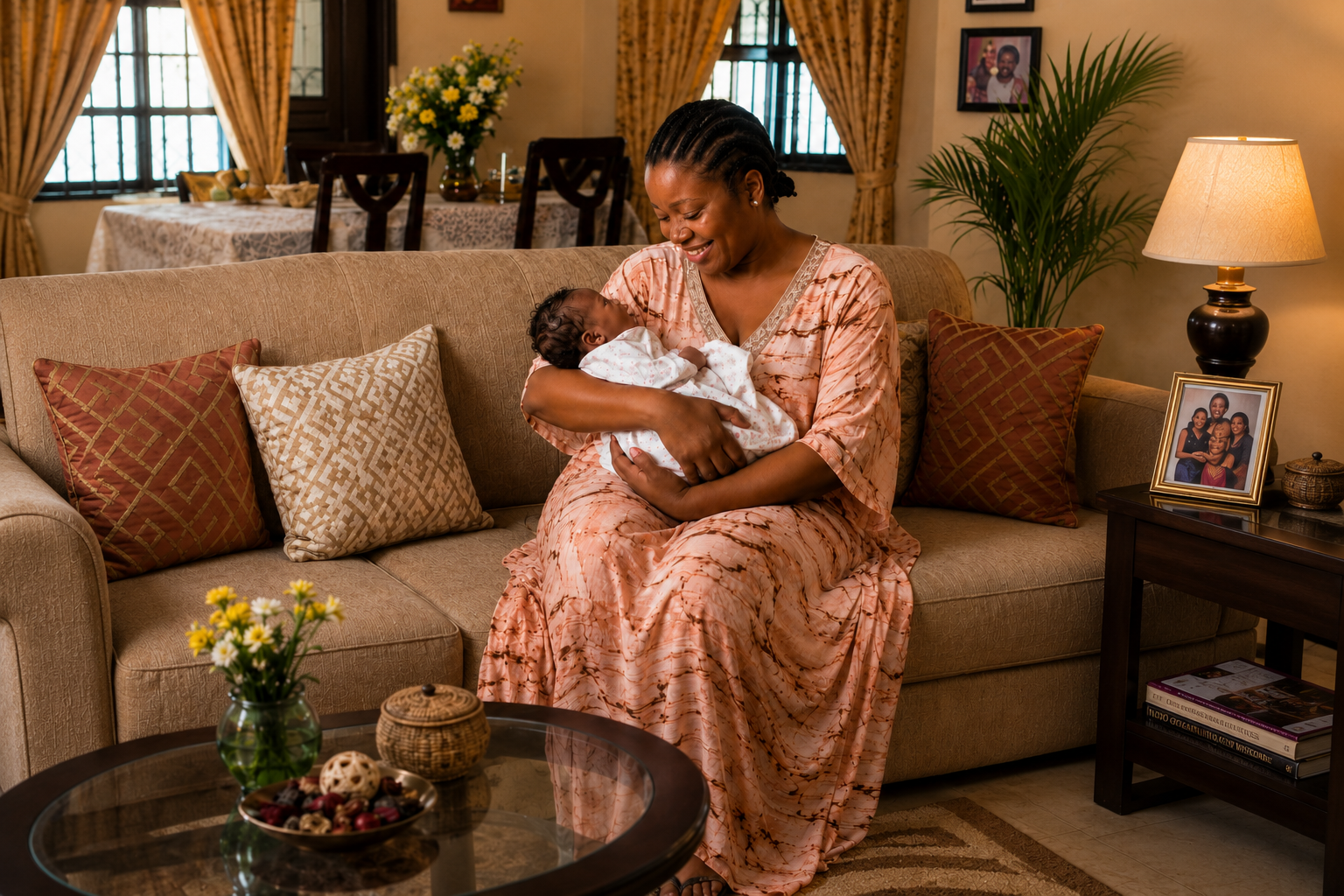
It was my miracle.
God did it through Nurse Feyi’s methods.
My recovery was nothing like the first time.
I could sit.
I could pee without shaking in fear.
I could poo without crying like before.
I kept thinking, “Why did nobody teach me this the first time?”
I began sharing the steps quietly with my pregnant friends.
One friend in Berger said, “Onyinye, write it down for me abeg.”
Another in Lekki said, “I wish I knew this before my first birth.”
That was how this guide was born.
Not from theory.
Not from trying to sound smart.
From pain.
From fear.
From healing.
From wanting first-time mums like you to enter birth with more calm and fewer regrets.
The Results You’d See When You Use The Method
Day 1
You understand why tears happen and what raises your risk.
The fear starts to feel less mysterious.
Day 3
You begin the gentle tissue prep steps and learn what to avoid.
Day 5
You know the key questions to ask at antenatal, especially if your baby may be big.
Day 7
You start building your birth-room plan, including how to discuss crowning support.
Day 12
You feel more ready for labour because you are no longer guessing.
Day 21
You have a clear prep and recovery plan, whether you need stitches or avoid a major tear.
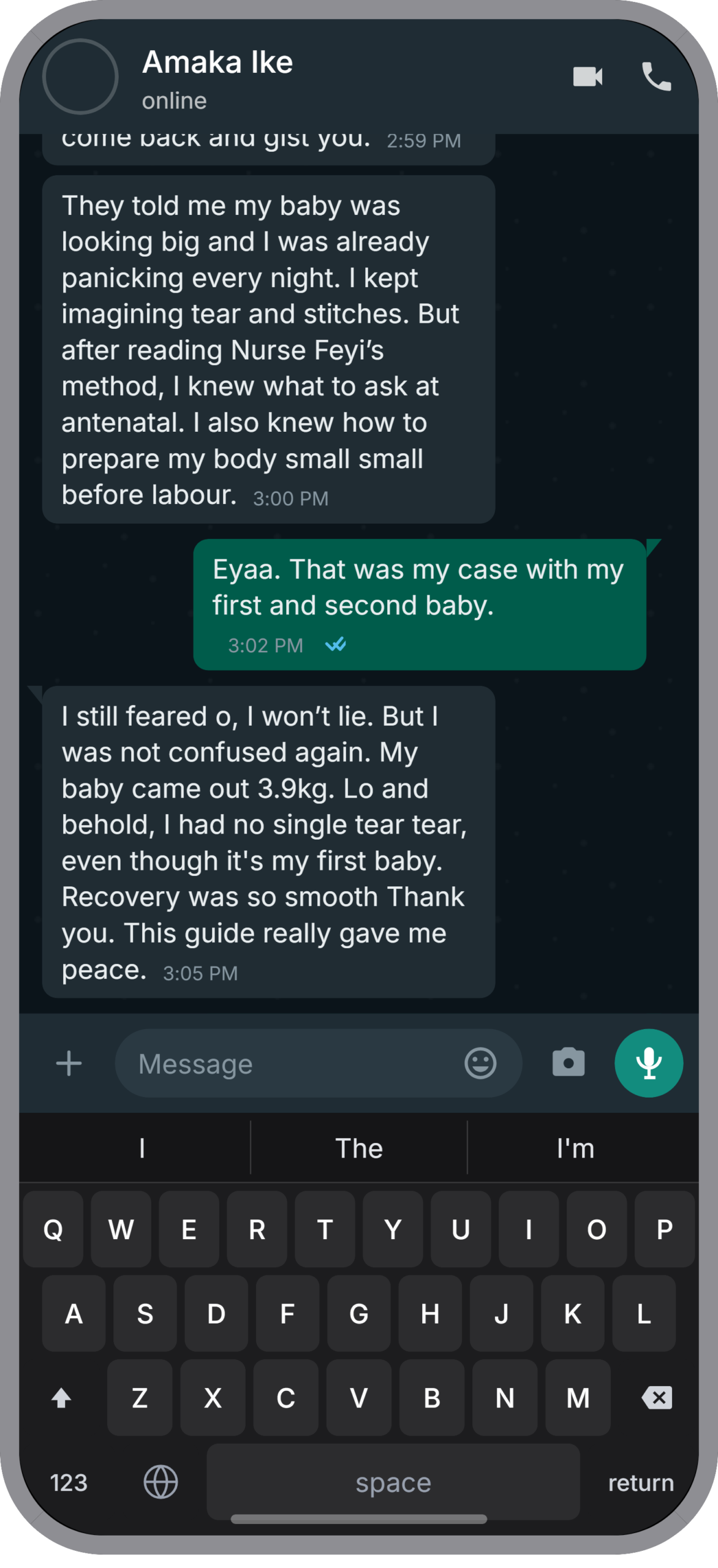
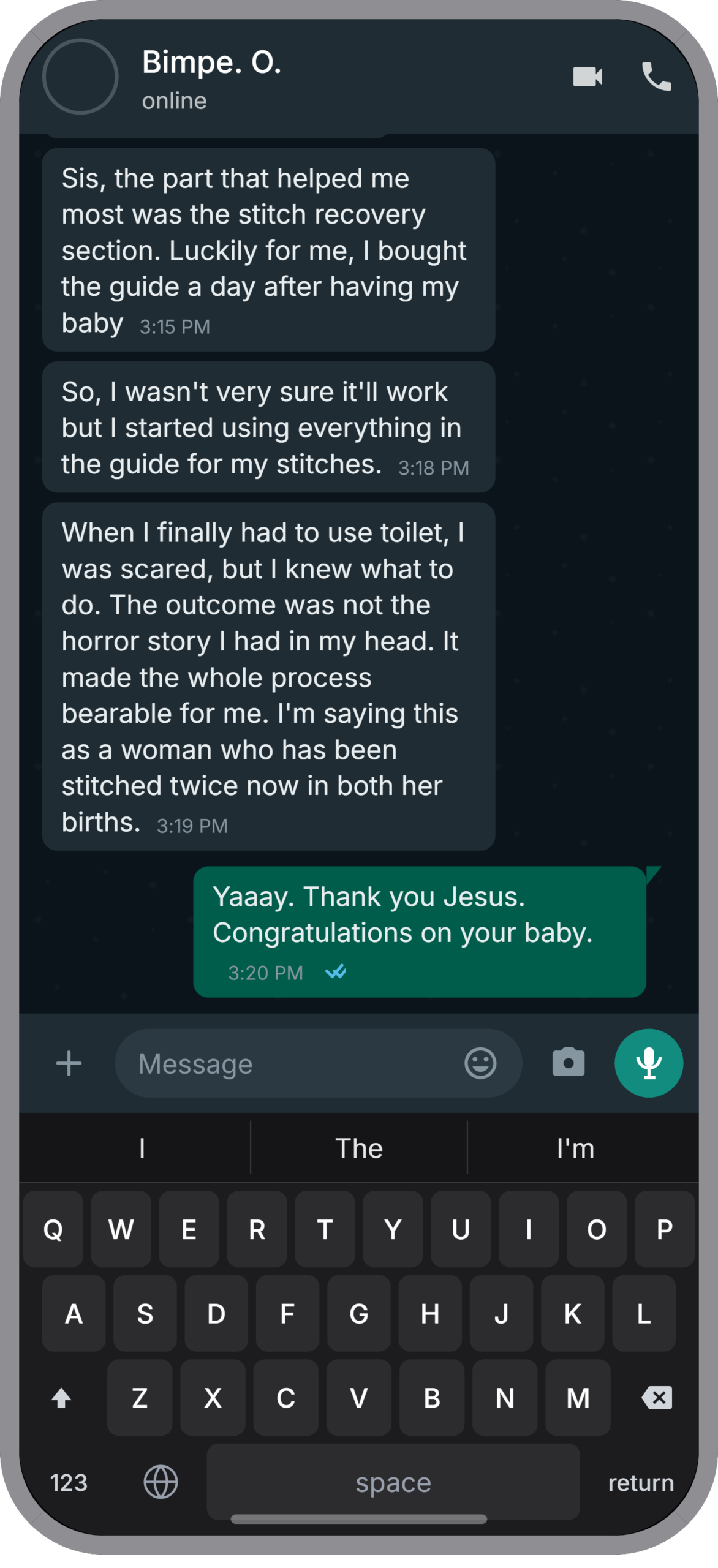
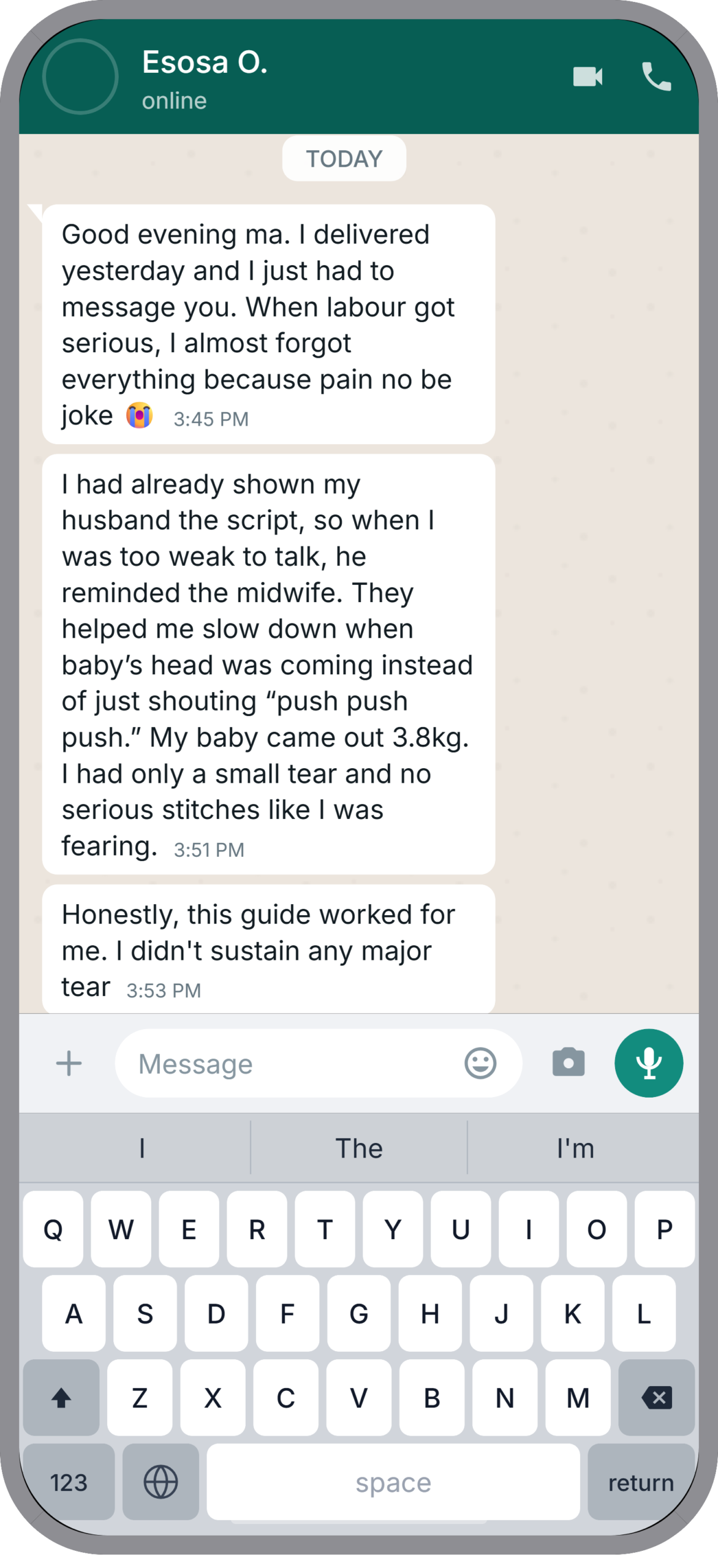
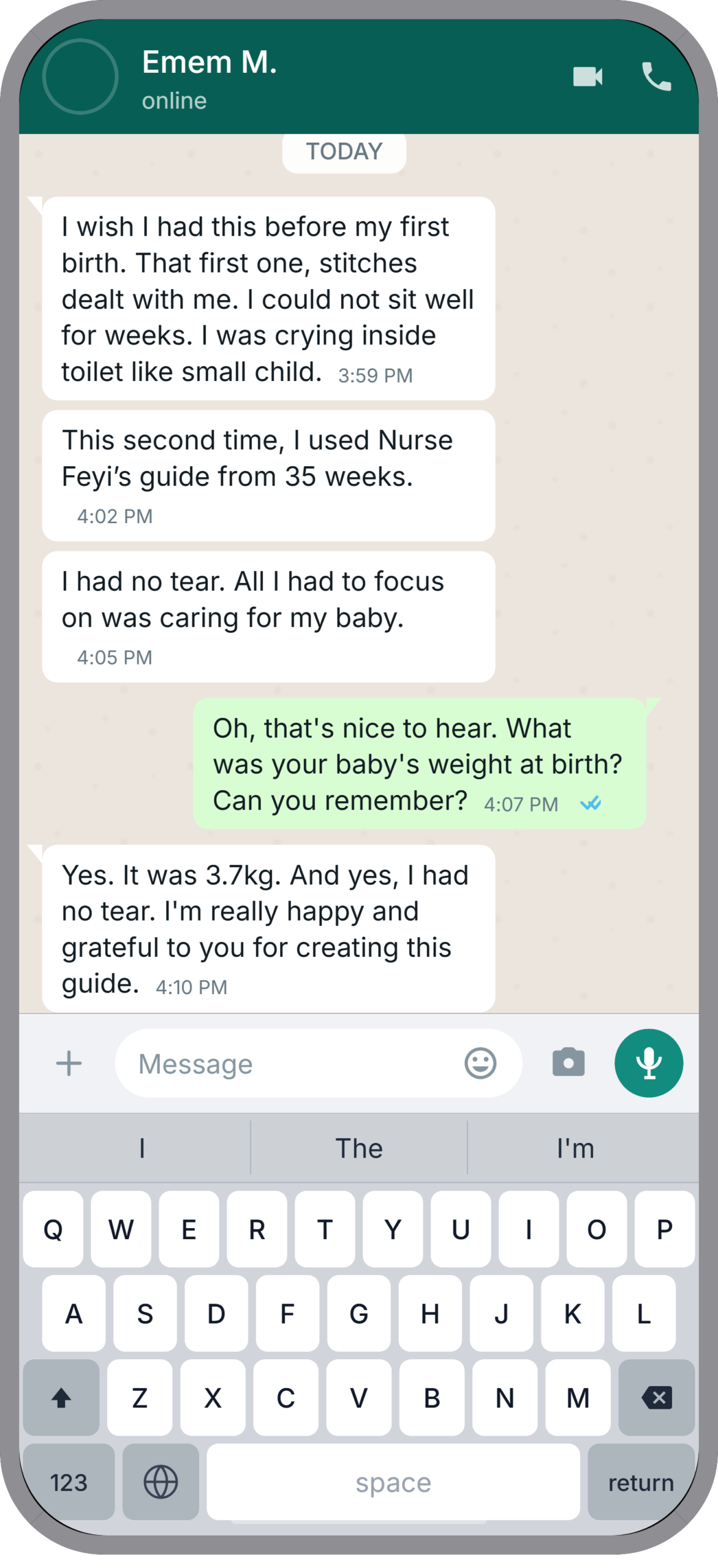
Real Messages From Women Using The Method
Swipe left or right to view more testimonials.
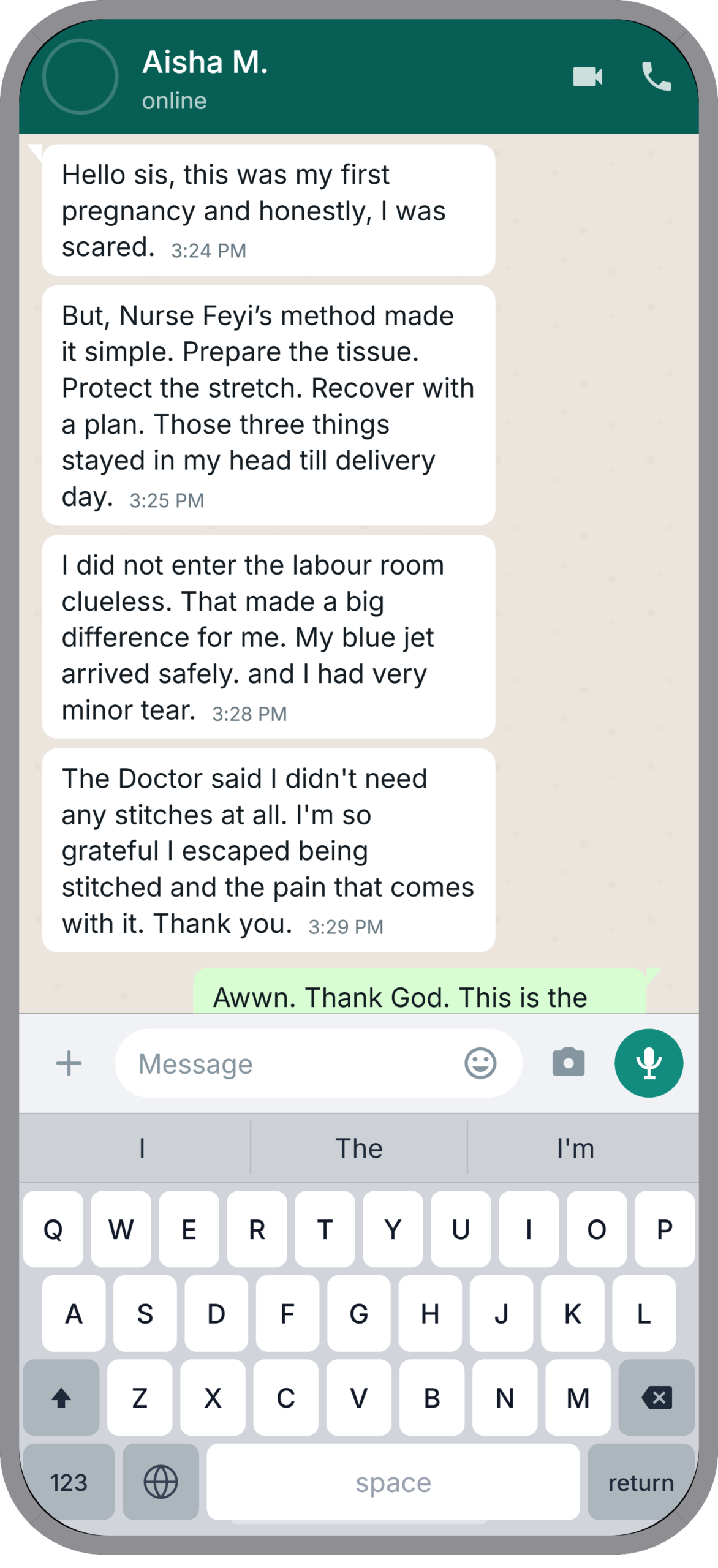
Now , You're Probably Thinking"But What If Labour Starts And I Can’t Remember Anything?”
That is a fair question.
Labour pain can be strong.
Contractions can make everything feel overwhelming.
But that is the beauty of how this method works.
It does not give you a list of steps to memorise in the middle of contractions.
It works before labour starts.
The tissue preparation happens in the weeks before birth, gently, at home.
The questions you need to ask happen at antenatal before labour day comes.
The recovery steps happen after birth, when the baby is already here and you have time to follow a calm guide.
The only thing you need to remember in the labour room are the two words Nurse Feyi gave me.
Slow. Breathe.
Everything else has already been prepared before you get there.
That is the difference between this method and random advice.
Random advice asks you to think clearly during the most overwhelming moment of your life.
This method does the preparation work before that moment arrives.
So when labour starts, you are not disoriented.
You are ready.
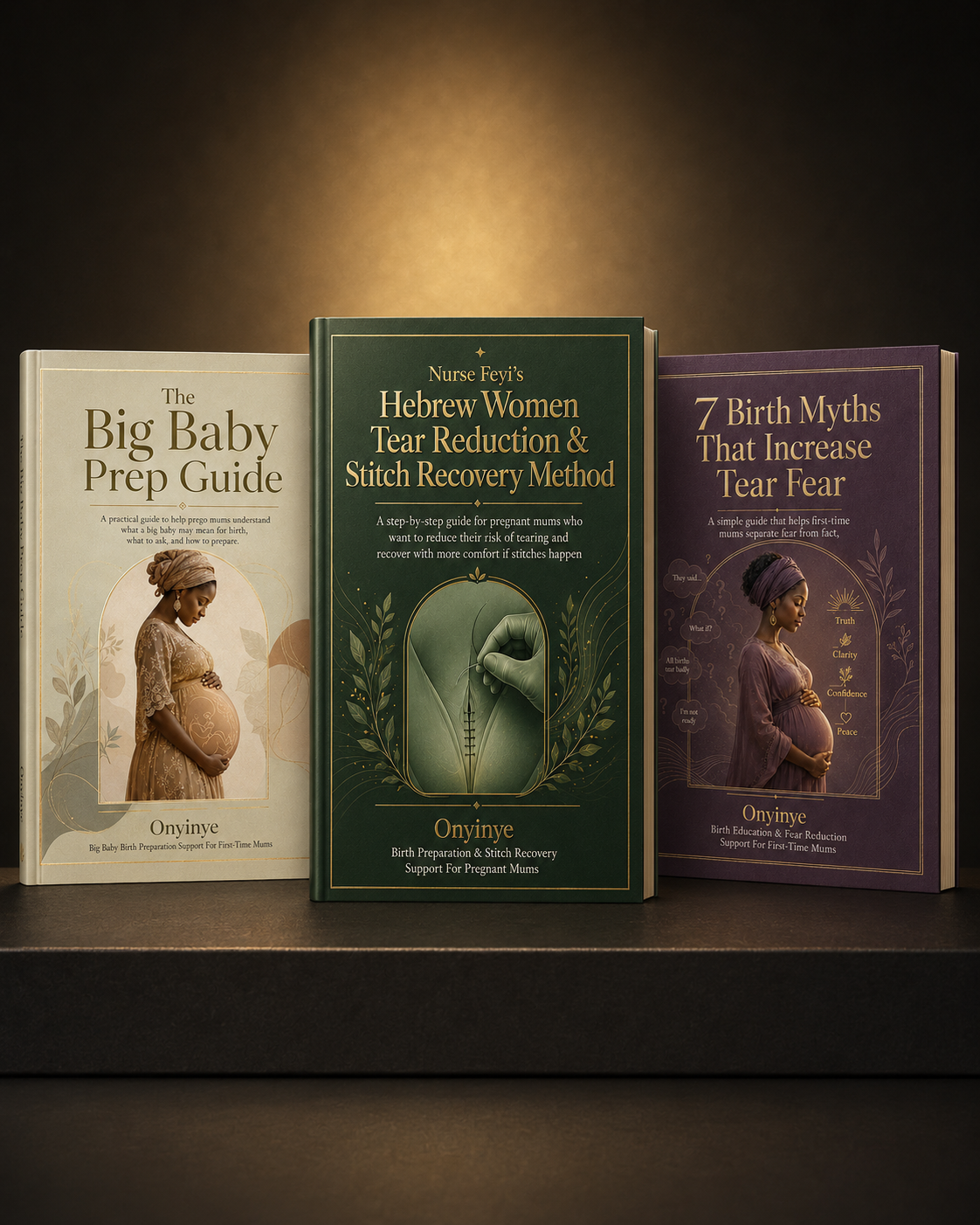
Introducing: Nurse Feyi’s Hebrew Women Tear Reduction & Stitch Recovery Method
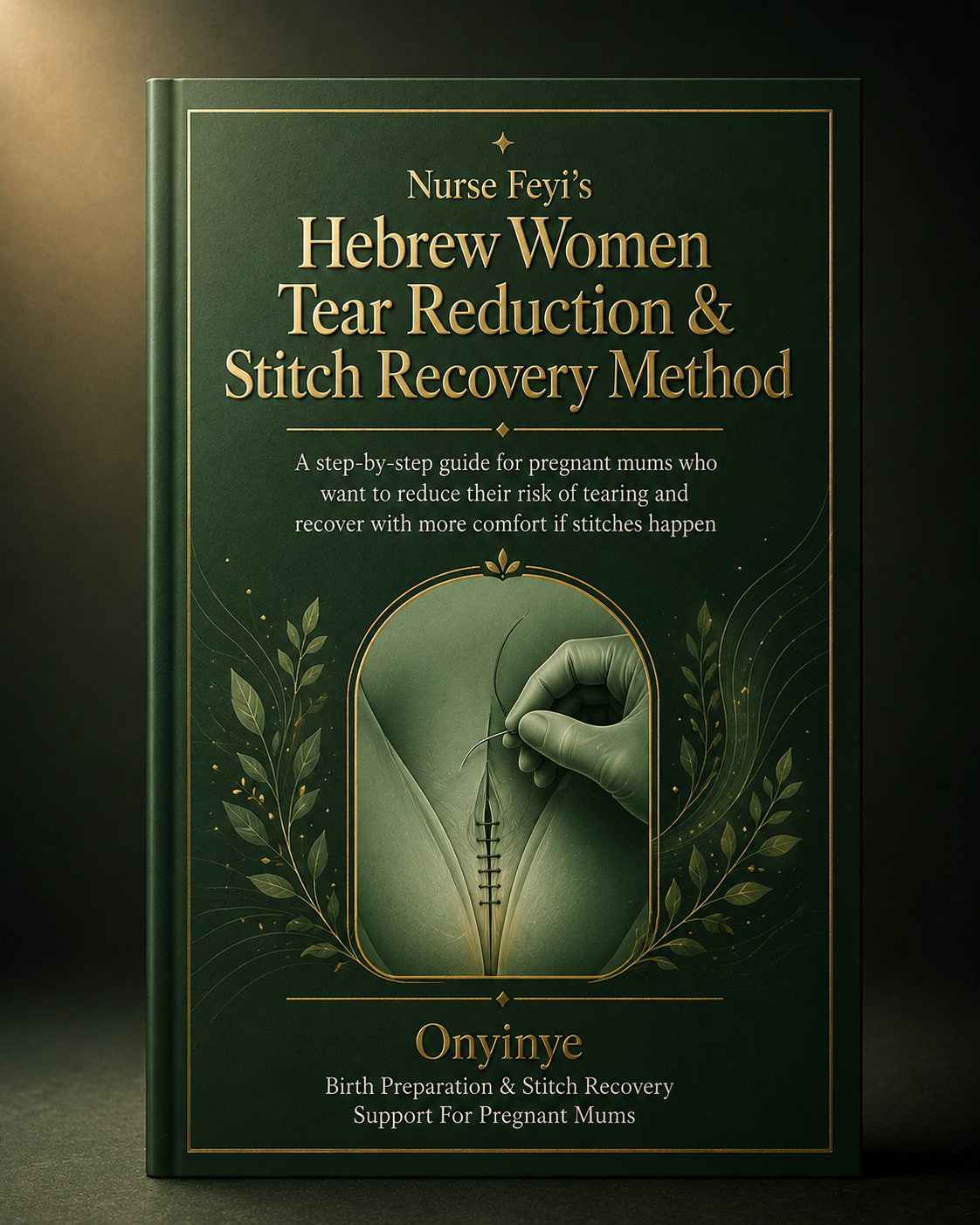
A step-by-step guide for pregnant mums who want to reduce their risk of tearing and recover with more comfort if stitches happen.
Inside, you get:
The Fear-Calming Birth Prep Letter — Pages 1–5
A gentle start that helps you understand your fear without shame.
Why Perineal Tears Happen — Pages 6–10
Simple, clear details on tissue stretching, pressure, first birth, bigger babies, and crowning.
The 3-Part Tear Risk Reduction Method — Pages 11–15
The core method: prepare, protect, and recover.
Gentle Tissue Preparation Steps — Pages 16–20
Easy steps to help you prepare your body before labour.
The Crowning Support Plan — Pages 21–23
What to discuss with your birth team before the baby’s head comes.
If You Get Stitched From Episiotomy — Pages 24–27
How to plan for recovery, sitting, cleaning, peeing, and pooping.
The First 14 Days After Birth — Pages 28–32
A calm recovery timeline for the early postpartum days.
Plus, You’ll Also Get These Two Bonuses
Just to help you walk into your next antenatal visit with a clearer head.
Bonus 1: The Big Baby Prep Guide
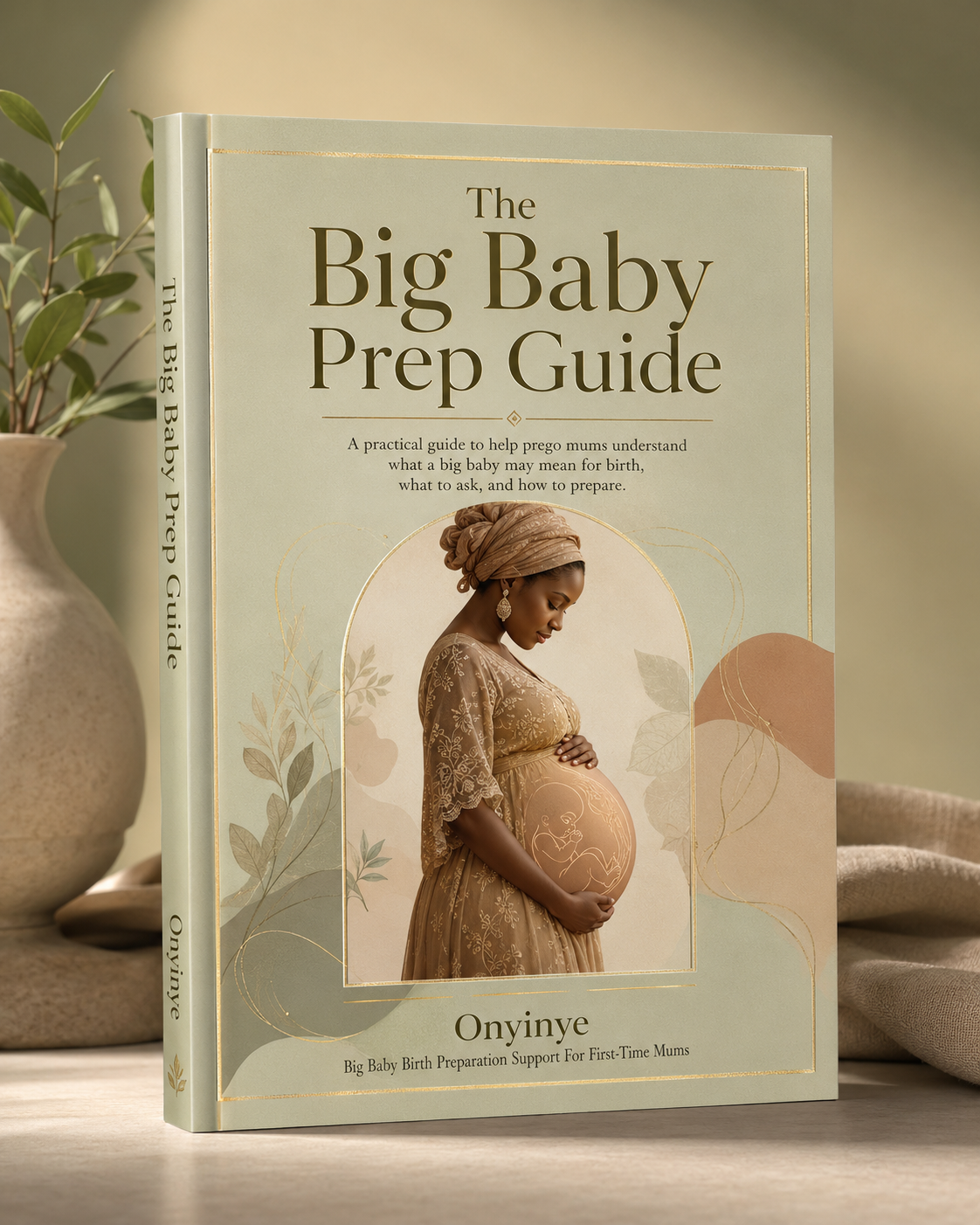
Standalone Value: ₦6,500
A simple guide that helps you understand what “big baby” may mean for your birth.
It shows you what to ask, how to prepare, and how to avoid panic when people start scaring you.
Bonus 2: The 7 Birth Myths That Increase Tear Fear
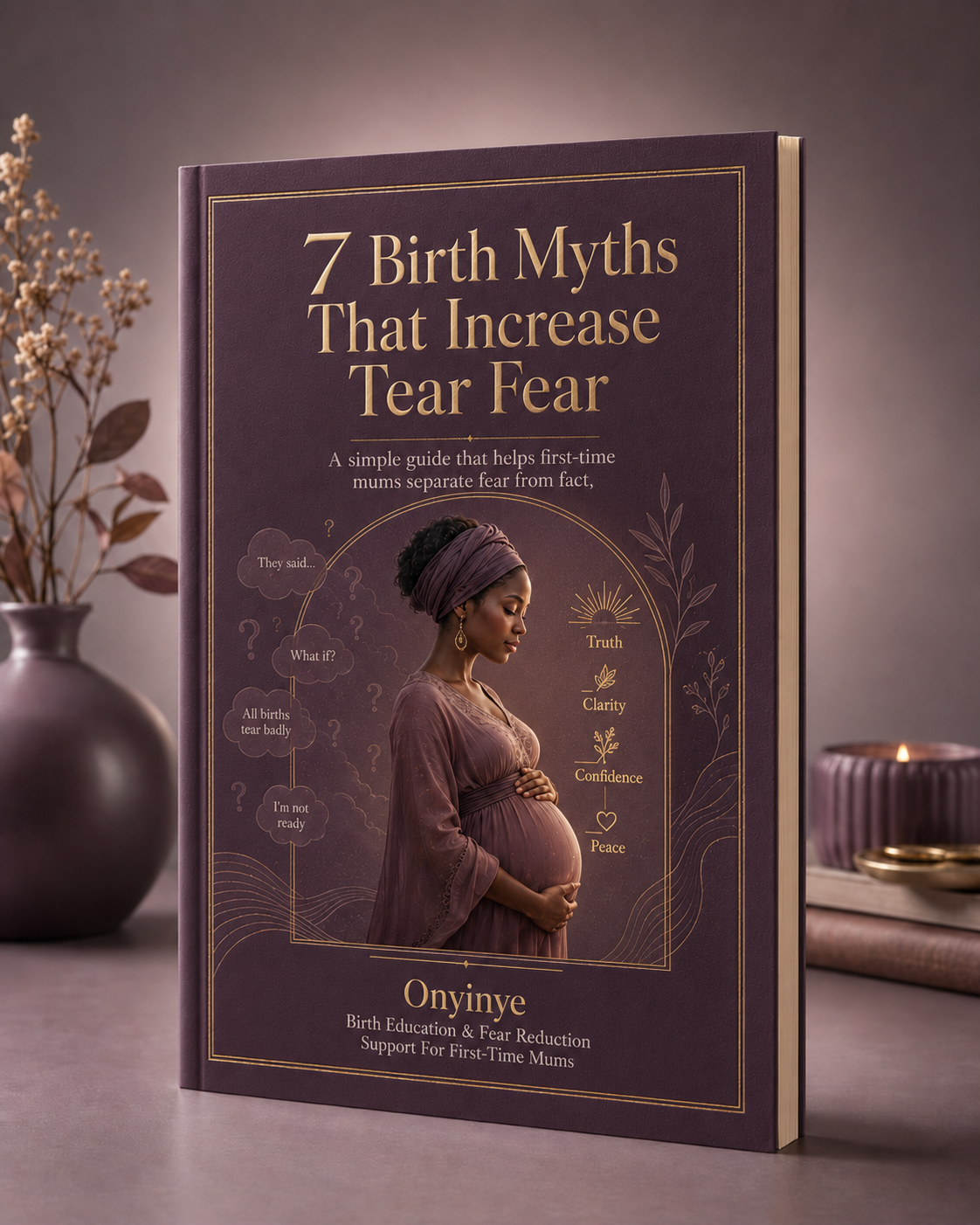
Standalone Value: ₦5,500
A simple myth-busting guide that helps first-time mums separate scary stories from real birth preparation, so they can go into labour with less panic and more confidence.
Here’s Everything You’ll Get At A Fraction Of The Cost
Your Price Today
After the first 35 buyers, both bonuses will be removed and sold at full price.
Before You Leave This Page, Know This
The two bonuses are only included for the first 35 buyers.
After that, they will be removed from this page and sold at full price.
If you have been waiting for a clear way to prepare before labour starts, this is the cheapest point to get everything together.
You are not only getting the main guide today.
You are also getting the Big Baby Prep Guide and the 7 Birth Myths guide while they are still bundled in.
Once the first 35 spots are gone, that offer ends.
Try The Method For Your Entire Pregnancy. You’re Protected By Our Money-Back Guarantee.

Read the guide.
Learn everything inside it and use it to prepare for your birth.
If you feel it did not help you reduce your tear risks, ask better antenatal questions, or prepare better for birth recovery, send me a message and request a refund.
You’ll get your money refunded to the last kobo.
That’s why the guarantee was extended up to 9 months, so that you would actually use it and see how it helps you.
Your peace matters more than any sale I’d ever make from this.
The Choice You Make Before Going Into Labour Matters
There’s one last thing I need to say to you.
And I won’t sugarcoat it.
You cannot keep carrying this fear and still pretend it is nothing.
Now that you know tearing is not just “one of those things”…
And now that you know your perineum can be prepared and supported so that you may have little or no tear…
It is up to you to do something about it before labour starts.
If you close this page now:
You are choosing to keep hoping instead of preparing.
You may tell yourself, “I’ll come back later.”
But later can easily become the day contractions start.
Later can become lying on the delivery bed, overwhelmed, scared, and unsure what is happening to your body.
Later can become hearing, “You had a bad tear, we need to stitch you,” and wishing someone had shown you what to do before that moment.
Later can become coming home with your baby while secretly dreading the first time you need to sit, pee, poo, or clean yourself.
And if they have already said your baby may be big, that fear may not leave on its own.
It follows you into labour.
It makes you tense when you should be guided.
It makes you panic when your body needs calm support.
It leaves you depending on random advice when what you really need is a clear plan.
Or you can make a different choice right now:
You can get Nurse Feyi’s Hebrew Women Tear Reduction & Stitch Recovery Method.
You can learn the 3-part method designed to help you prepare your body before vaginal birth, reduce avoidable tear risk, and recover with more calm if stitches happen.
You can stop depending on scary Facebook mummy group stories.
You can stop entering antenatal visits with questions you are too afraid to ask.
You can stop treating “deliver like the Hebrew women” as only a prayer and start adding preparation to your faith.
One choice leaves you guessing until labour starts.
The other helps you prepare before your body is under pressure.
One choice keeps you stuck in fear.
The other gives you a simple plan to prepare, protect, and recover.
So do not make this bigger than it needs to be.
Click the button below.
Get the guide.
Read it.
Follow the method.
Ask better questions.
So that after birth, you are not holding your poo because you are scared of pain.
But holding your baby with peace, because you prepared before labour day came.
That is what this guide gives you.
Not a perfect birth guarantee.
But the calm, clear preparation many pregnant mums wish they had before entering the labour room.
That kind of peace is worth more than ₦8,900.
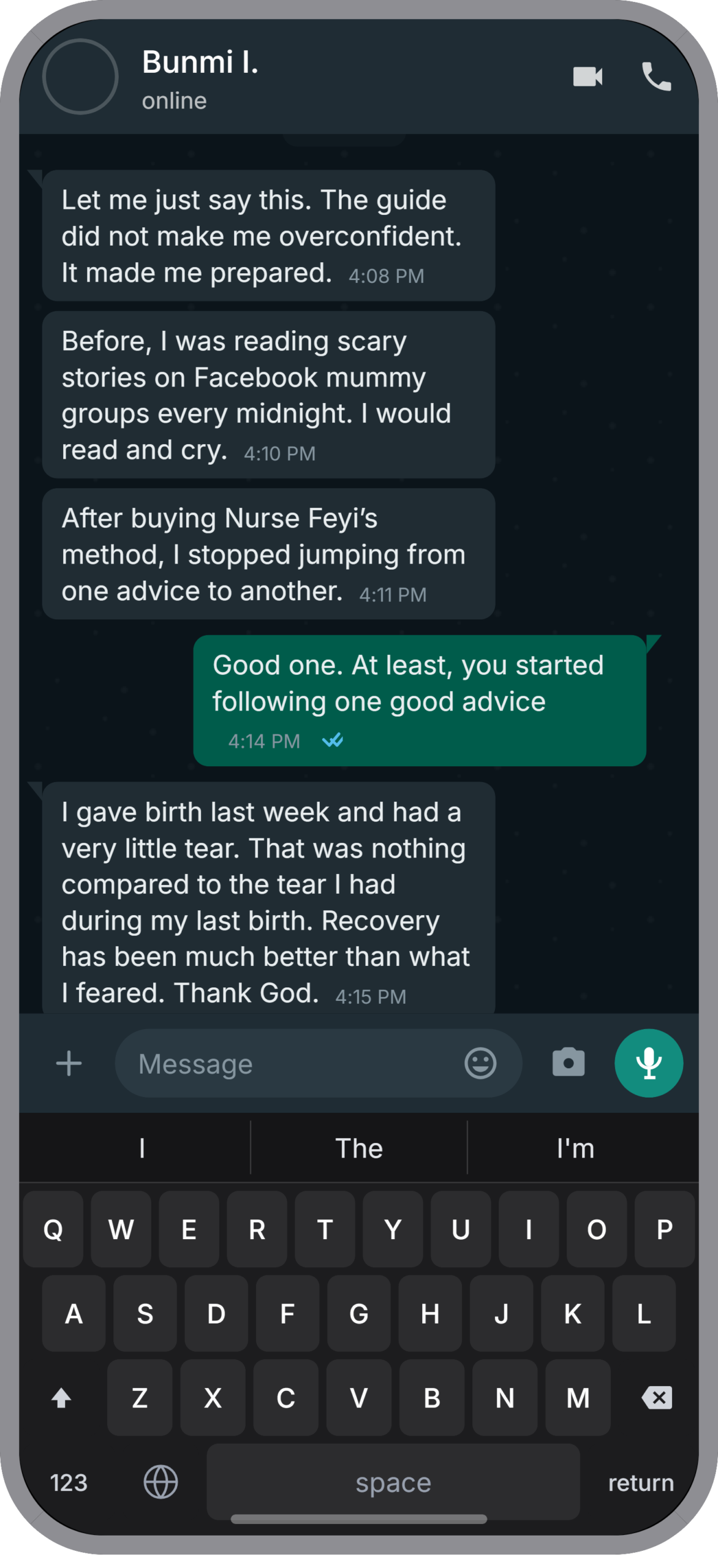
More Testimonials From More Women
Swipe left or right to view more testimonials.
P.S. You are covered by our 9 Months guarantee. You’d get a full refund if you think this method did not work for you.
Final Note
The two bonuses are only included for the first 35 buyers. After that, you’ll buy them at full price if you still want them.
You deserve to meet your baby without silently fearing what birth may do to your body.
The pain of carrying a child and experiencing labour is enough suffering already.
Don’t let yourself experience another needless pain when you can do something to change it.